Adentris: Revenue, team and how it was built
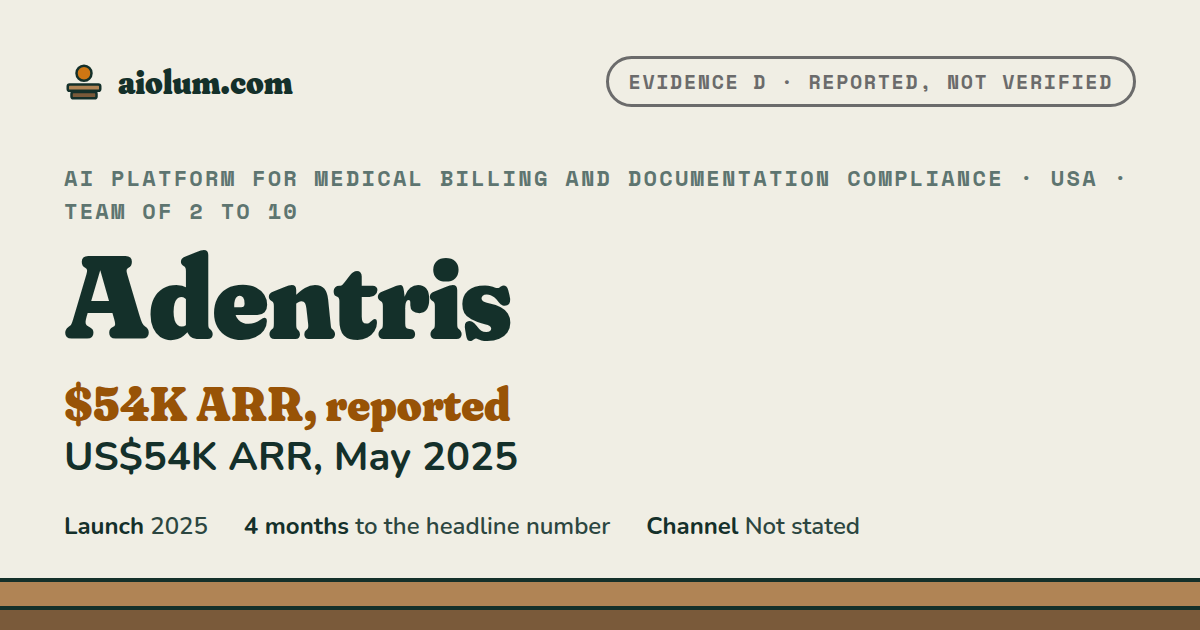
Adentris (AI platform for medical billing and documentation compliance, USA): US$54K ARR, May 2025. Evidence grade D: reported, not verified. Team: 3 co-founders; the Y Combinator page lists 5 people (read 12 November 2026). Launched 2025; still running.Added
- Outcome
- US$54K ARR, May 2025
- Evidence
- D reported, not verified
- Launch
- 2025
- Status
- Still running
- Team
- 3 co-founders; the Y Combinator page lists 5 people (read 12 November 2026)
- Outside funding
- US$1.8M pre-seed round in April 2025, as the company reports
- Main channel
- Not stated
What is not verified
The revenue figure rests on one founder statement dated 8 May 2025. The three co-founders wrote it in their Y Combinator launch post, and a Y Combinator bio gives a similar undated figure. The word ARR is not defined, and the post does not say whether its pilots paid. No payment-processor profile, buyer or journalist confirms revenue or paying customers. The Sobrius Health release was written by the company. A reader could look for a payment-processor profile, a funding database entry or a second interview. The headline number is grade D: one claim or one estimate, with no second source. Aiolum shows it because the story is useful, and marks it so that it is not mistaken for a verified figure.
Adentris is an AI platform for revenue integrity. That means making sure that delivered care is documented and coded well enough to be paid. It reads charts and claims in the provider's EHR (electronic health record, the clinic's patient-record system). It flags missing notes, wrong billing codes and gaps in prior authorization (the payer's approval before treatment). The company says it started in behavioral health and substance use disorder treatment.
The company's about page says it was founded in 2025. Y Combinator lists Adentris in its Spring 2025 batch. The press release of 18 September 2025 says the company was called WorkDone Health before that date. Three co-founders are named: Dmitry Karpov (chief executive), Sergey Yudovskiy (chief product officer) and Alex Odin (chief technology officer). The company said in its blog that it closed a US$1.8 million pre-seed round that took place in April 2025.
The only money figure is a founder statement. In their Y Combinator launch post of 8 May 2025 the three co-founders wrote: "Since the beginning of YC, we've reached $54k ARR". The post does not say how many customers paid or whether the pilots it mentions were paid. No payment processor, buyer or journalist has confirmed the figure, so the grade is D.
Why did Adentris work?
Four causes, in the order they mattered. Each one is a reusable lesson.
It began in one field where the company says rules are strictest
The company's about page says it started in behavioral health and substance use disorder treatment. It gives the reason in these words: "where the rules are strictest and the margins are thinnest". The page also says that if the platform works there, it works anywhere. The founders' launch post says that documentation errors lead to denied claims, failed audits and fines.
A software agent reads the screen when the record system has no interface
The home page says the company's AI Web Agent reads the EHR "by logging in, navigating, and looking". Where a system has an API or HL7 feeds, the page says the platform uses those too. The company presents this as the reason a deployment takes weeks and needs no integration project. This is the company's own claim, and no outside party tested it.
It offers a pilot on the customer's own charts before a contract
The pricing page says that a rapid audit pilot runs on the customer's own charts and claims before any commitment. The Y Combinator launch post reports pilots with hospitals and clinics. The company's blog says its first clients came in 2025, mainly in drug and alcohol rehabilitation.
It adds services and managed billing next to the software
The terms of use describe managed billing services, where the company performs billing operations for a customer on the platform. The services page lists three engagements. The Y Combinator page says the company runs billing as a service for providers without their own billing teams. The sources do not say how much revenue comes from services.
How it was built
These details come from the company's own pages, press releases and blog. They are grade C. No outside engineer has reviewed them. [4, 5, 6, 8]
- Five modules on one platform: documentation compliance, coding quality checks, prior authorization, appeals and denials, and discharge summaries. The home page lists them.
- An AI Web Agent that reads the EHR through its user interface. Where the EHR offers an API, FHIR or HL7 feeds, the company says it uses them as well.
- Inference runs on Microsoft Azure under a signed business associate agreement. The home page says that no patient data goes to external language model APIs.
- Customers pay through a contract with an annual term. The pricing page says "monthly payment available". The archived Starter plan was billed through Stripe.
- The website names Epic, athenahealth, eClinicalWorks, Kipu Health, Alleva, Ritten, Ease Health and PIMSY as systems it connects to.
Tools named in the sources
Each one opens its page in the Tools tab, with every story that uses it.
Who tried this before Adentris, and why did they fail?
Three companies in our database of failed startups tried to automate healthcare administration or to sell AI to health providers. The values below come from that database, which labels its entries as AI-assisted summaries that are not verified, and its pages do not name founders.
Olive AI
The promiseSoftware bots that automate hospital tasks such as prior authorization, claims denials and eligibility checks.
Why it diedThe database says each hospital needed custom integrations, the bots broke when hospitals changed systems, and the cost to serve was above revenue.
CareLedger
The promiseA platform that tracked and managed patient billing and insurance claims for providers.
Why it diedThe database says it could not reach scale or connect to the large EHR systems fast enough against bigger competitors.
Babylon Health
The promiseAI symptom checking and virtual doctor visits on a smartphone.
Why it diedThe database says the AI claims were not validated. Doctor costs grew with use while fees were fixed. Expansion in many countries added regulatory burden.
The failed startups come from our database of 1,749 dead startups, retold here in our own words. Its entries are AI-assisted summaries of public sources, so these cards carry no evidence grade.
What changed
The closest predecessor is Olive AI. The the failed-startup database entry for it says that its bots needed a custom integration for each hospital and broke when systems changed. Adentris says it reads the EHR screen with an AI agent and needs no integration project. That claim addresses the failure the database describes, but no independent party has tested it.
Adentris also sells narrower work than Olive AI did. Its sources describe one field, behavioral health, and five modules for charts, claims and prior authorization. Olive AI, as the database summarizes it, tried many use cases at once. CareLedger and Babylon Health show the other risks in the same market: slow EHR access and costs that grow with volume.
Can one person copy Adentris now?
Possible for a team with healthcare and enterprise sales experience, not for a solo founder.
The sources show a small team that picked one regulated niche, named two customers and offered a pilot before a contract. The same sources do not show that anyone pays at scale. A reader who copies the structure should expect long sales cycles, security reviews and business associate agreements before the first paying customer.
Where it is still open: Other narrow back-office fields with strict rules, for example claims for one specialty, or audits for one regulator.
- 1Pick one field with strict documentation rules and a clear cost for each error, as the company did with behavioral health.
- 2Offer a pilot on the customer's own data, so the finding is the sales pitch.
- 3Prepare the security paperwork early: a business associate agreement, a SOC 2 report and a data-residency statement.
- 4Keep a small self-serve plan beside enterprise contracts, as the archived pricing page did, if the market has small clinics.
How much revenue does Adentris make?
Each row shows the evidence grade and the source numbers from the list at the end of this page. The grades are explained in How Aiolum verifies.
| Fact | Value | Grade | How we know | Sources |
|---|---|---|---|---|
| Annual recurring revenue, May 2025 | US$54,000 | D | The three co-founders wrote in their Y Combinator launch post of 8 May 2025: "Since the beginning of YC, we've reached $54k ARR". The post also reports "a growing number of commercial pilots". | [1] |
| Another founder statement on the same Y Combinator profile | US$55K ARR from 3 clinics | D | The bio of Alex Odin on the Y Combinator company page says: "Launched 4 weeks ago, already at $55K ARR from 3 clinics". The bio has no date. | [2] |
| Company start | 2025 | C | The about page says "Adentris was founded in 2025". The Y Combinator page gives the year 2025 and the batch Spring 2025. | [3, 2] |
| Earlier name | WorkDone Health, renamed Adentris on 18 September 2025 | C | The company's press release of 18 September 2025 says: "WorkDone Health ... today announced it has rebranded as Adentris". No source read gives a date for the start of WorkDone Health. | [9] |
| Time from the start of 2025 to May 2025 | 4 months | calc | Calculated: January to May 2025. The company's blog says that "Since the beginning of 2025" it won its first healthcare clients. No source gives a launch day. | [11, 1] |
| Team | 3 named co-founders; 5 people on the Y Combinator page | C | The about page names the three co-founders. The Y Combinator page lists a team size of 5. The footer of the website says the team is in Reno, San Francisco, Austin and remote. | [3, 2, 4] |
| Funding | US$1.8 million pre-seed | C | The company's blog post of 12 September 2025 says the round "took place in April this year" with Pioneer Fund, DVC, Fjor and two named angel investors. The about page names the same backers. | [11, 3] |
| Y Combinator batch | Spring 2025 | C | The Y Combinator company page and the founders' launch post both give the Spring 2025 batch. | [2, 1] |
| Named customers with case studies | 2: Sobrius Health and Resilient Recovery Treatment | C | Both case studies are on the company's website. The Resilient Recovery executive named there appears on Resilient's own about page as chief operating officer. No source says what either customer pays. | [13, 14] |
| Sobrius Health deployment | live in under 60 days, more than 100 active patients, more than 20 staff users | C | The company's press release of 20 May 2026, distributed by EIN Presswire, says the platform went "from contract to live operations" and that the full deployment took "well under 60 days". | [10] |
| Resilient Recovery results | documentation accuracy 73% to 96%, denials down 62% in 90 days, 7.6 times return in 4 months | C | The company's case study says the figures are "Sourced from Resilient Recovery 90-day audit, Q4 2025". The company's blog attributes the 73% to 96% change to Sobrius Health instead. | [13, 11] |
| What is sold | software modules, plus audits and managed billing | C | The home page lists five modules. The services page lists three engagements "delivered by the Adentris team". The pricing page names "Managed billing services" in the enterprise tier. No source states the share of revenue from services. | [4, 12, 5] |
| Reseller partnership | Grant Global & Associates, 19 August 2026 | C | The company's blog announces a signed partnership under which the partner will resell and implement the five modules for private-equity-backed behavioral health operators. | [15] |
| Accelerator program | Creative Destruction Lab, Computational Health stream, October 2025 | C | The company's press release of 21 October 2025 says it was accepted into the stream. | [16] |
| Chief executive's role, July 2026 | named as chief executive of Adentris | B | Acuity News, an independent news site, wrote on 6 July 2026 that Dmitry Karpov is the chief executive officer of Adentris. | [17] |
| Security statements | SOC 2 Type I and Type II, HIPAA business associate agreement, 42 CFR Part 2 | C | The company's home page says it completed SOC 2 Type I and Type II attestations. It offers the report "under NDA". No report was read. | [4] |
How to read this table. Grade D is a founder or company statement that rests on one source and one date. Grade C is a statement on the company's own pages. Grade B is a report by an independent news site. A "calc" value was computed on this page.
| Plan | Per month, billed yearly (US$) | Per month, billed monthly (US$) | Limit |
|---|---|---|---|
| Free | 0 | 0 | 5 charts, 5 claims, 5 benefit checks, 5 prior auths per category; document upload only |
| Starter | 100 | 25 of each per month; document upload; no EHR link | |
| Enterprise | custom annual | Unlimited volume; EHR link; custom rules |
The archived page lists three plans: Free, Starter and Enterprise. Starter is paid by card through Stripe with no contract. Enterprise is a custom annual fee tied to provider count, modules and deployment. The live page says: "Annual agreement, monthly payment available. Priced on provider count and chart or claim volume." That page lists no amounts. The terms of use also mention managed billing services fees, which are invoiced monthly.
When did Adentris launch, and how did it grow?
From a start in 2025 to named customers and a reseller partnership in 2026. Each entry carries its grade, and the revenue figure appears once.
- 2025CThe company says it was founded. Y Combinator lists it in the Spring 2025 batch. The earlier name was WorkDone Health. [3, 2, 9]
- April 2025CThe company says it closed a US$1.8 million pre-seed round. [11]
- 8 May 2025DThe co-founders post on Y Combinator's launch page and say they reached US$54,000 in annual recurring revenue. They also report commercial pilots with hospitals and clinics. [1]
- 18 September 2025CWorkDone Health announces that it is now Adentris and adds an acute care product for hospitals. [9]
- 21 October 2025CThe company announces its acceptance into the Creative Destruction Lab Computational Health stream. [16]
- Q4 2025CThe 90-day audit at Resilient Recovery Treatment, which the company's case study cites. [13]
- 20 May 2026CThe company announces that the Sobrius Health deployment is live. It announces five production modules on the same day. [10, 2, 4]
- 8 June 2026CAn archived pricing page lists a free plan, a Starter plan paid by card and a custom Enterprise plan. [6]
- 6 July 2026BAcuity News publishes an article on offshore billing and unsupervised AI tools. The reporter spoke with the company's chief executive. [17]
- 19 August 2026CThe company announces a reseller and implementation partnership with Grant Global & Associates. [15]
- 12 November 2026CThe live pricing page lists no amounts and offers a pilot on the customer's own charts before a contract. [5]
What could go wrong for Adentris?
The risks are the mirror image of the causes above.
What is not verified
The revenue figure rests on one founder statement dated 8 May 2025. The three co-founders wrote it in their Y Combinator launch post, and a Y Combinator bio gives a similar undated figure. The word ARR is not defined, and the post does not say whether its pilots paid. No payment-processor profile, buyer or journalist confirms revenue or paying customers. The Sobrius Health release was written by the company. A reader could look for a payment-processor profile, a funding database entry or a second interview.
Services and managed billing
The company sells services as well as software. The services page lists audits and monitoring "delivered by the Adentris team", and the enterprise tier offers managed billing where the company runs the operation. The Y Combinator page says the same about billing as a service. No source states how much revenue comes from software and how much from services.
Logo walls, counters, badges and testimonials
The home page shows a customer logo wall of seven names and a second wall of partners and programs. Two customers have case studies; the others have no page that says what they use or pay. A wall of nine media logos has a link to one article only. Two counters show 0 without scripts. The SOC 2 and HIPAA badges have no public report. Two named testimonials appear, and one of them also appears in the company's own press release.
Pricing page changed
The pricing page of 8 June 2026 listed a free plan and a card-paid plan. The live page of 12 November 2026 lists no amounts and says the work is scoped to the organization. Two company pages also differ. The website attributes the 73% to 96% accuracy change to Resilient Recovery, and the blog attributes it to Sobrius Health. The blog post is dated 12 September 2025 but describes the Sobrius deployment, which the company announced on 20 May 2026.
Regulated use of AI with patient data
The product handles protected health information and suggests billing codes. Its AI Web Agent logs in to record systems and, according to the company, payer portals. The company says inference runs on Azure under a business associate agreement. The Y Combinator launch post says the product monitors clinical staff activity logs. The pricing page lists a dashboard "with per-location and per-clinician view". This research did not test any of these statements.
Earlier name and company start
The company was called WorkDone Health until 18 September 2025. The Y Combinator launch post is dated 8 May 2025 and was last updated in November 2026. It uses the name Adentris, but its contact address is at wrkdn.com and its calendar link ends in workdone-demo. The earlier domain refused automated access, so no date for the start of WorkDone Health was found. The about page and Y Combinator both say 2025. The founders' earlier companies are separate businesses.
Sources
The grade next to each source is the best grade that the source can support. "Read in full" means that the text of the page was downloaded and the numbers were checked in it.
- D Y Combinator Launch YC, 8 May 2025: Adentris - AI compliance autopilot for hospitals and clinicsRead in full as downloaded JSON. Written in the first person plural by the three co-founders. Source for the US$54,000 ARR statement and the commercial pilots.
- C Y Combinator company page: AdentrisRead in full. Source for the year 2025, the batch, the team size of 5, the founders' bios and the services description.
- C Adentris, About usRead in full. Source for the founding year, the three co-founders and the backers.
- C Adentris home pageRead in full, including the logo walls, counters and badges. Source for the modules, the AI Web Agent and the security statements.
- C Adentris pricing page, read 12 November 2026Read in full. It lists no prices and says why. Source for the contract terms and the managed billing line.
- C Internet Archive copy of the Adentris pricing page, 8 June 2026Read in full. Source for the Free, Starter and Enterprise plans and the Starter price of US$100 a month.
- C Adentris, Terms of use, last updated 13 August 2026Read the sections on managed billing services, fees and age. Source for the managed billing services description.
- C Adentris, Privacy policy, last updated 20 May 2026Read in full. Source for the subprocessors Microsoft Azure and Stripe.
- C EIN Presswire, 18 September 2025: WorkDone Health Rebrands as Adentris and Launches Acute Care SolutionRead in full. A release by the company, distributed by a release service. Source for the earlier name WorkDone Health.
- C EIN Presswire, 20 May 2026: Adentris Completes Major AI Compliance Deployment at SobriusRead in full. A release by the company, distributed by a release service. Source for the Sobrius deployment.
- C Adentris blog, 12 September 2025: Raises $1.8M in VC Funding to Transform Medical Documentation Compliance With AIRead in full. The company's own blog. Source for the pre-seed round and the first clients in 2025.
- C Adentris, Services, and the pages AR Audit and RCM Insights and Payer Audit ReadinessRead the services page and the two service pages in full. Source for the services the company's team delivers.
- C Adentris case studies: Resilient Recovery Treatment and Sobrius HealthRead both case study pages in full. Company pages with the customers' quotations and the company's figures.
- C Resilient Recovery, About usRead the team section. It lists the executive named in the case study as chief operating officer.
- C Adentris blog, 19 August 2026: Adentris and Grant Global & Associates Partner on Revenue IntegrityRead in full. The company's own blog. Source for the reseller partnership.
- C EIN Presswire, 21 October 2025: Adentris Selected for Creative Destruction Lab Computational Health ProgramRead in full. A release by the company. Source for the accelerator program.
- B Acuity News, 6 July 2026: Offshore Medical Billing and Shadow AI: The Behavioral Health Patient Data Privacy Gap No One Is AuditingRead in full. An independent news article. Source for the chief executive's role.
- C Database of failed startups, local exportRecord pages for Olive AI, CareLedger and Babylon Health read on the website on 12 November 2026. AI-assisted summaries, not independently verified. Source for the failed predecessors.
Run this company? Send corrections or a verified figure to aiolum@livyden.com