Empromptu: Product, team and how it was built
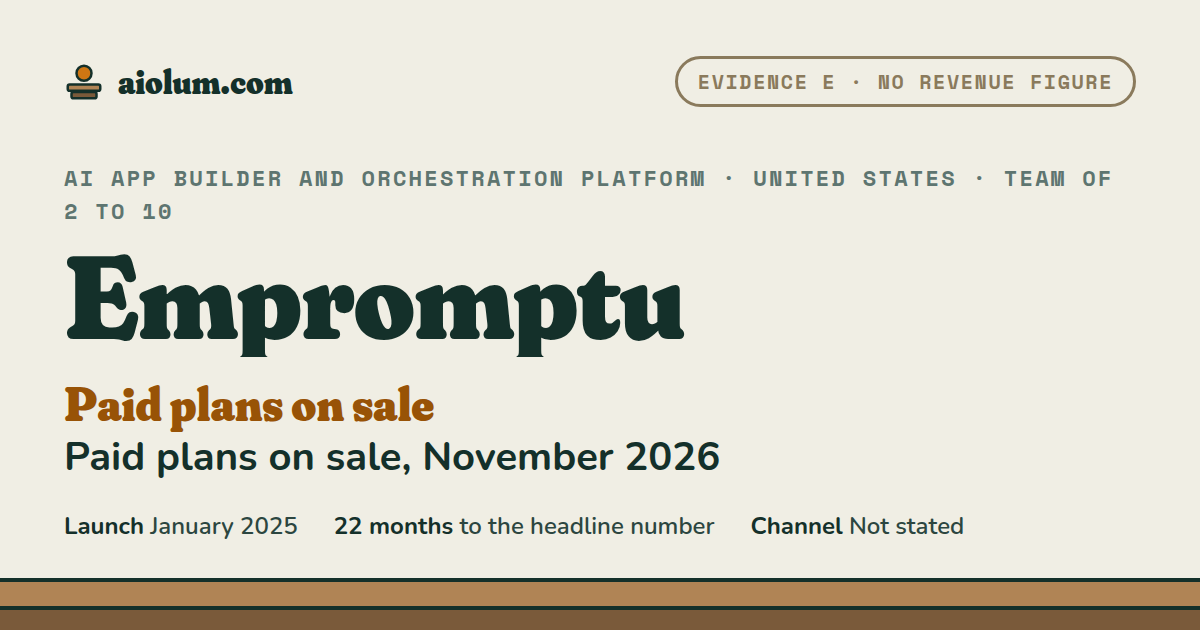
Empromptu (AI app builder and orchestration platform, United States): Paid plans on sale, November 2026. Evidence grade E: no revenue figure was checked. Team: 2 co-founders named on the company's About page; headcount not published. Launched January 2025; still running.Added
- Outcome
- Paid plans on sale, November 2026
- Evidence
- E no revenue figure was checked
- Launch
- January 2025
- Status
- Still running
- Team
- 2 co-founders named on the company's About page; headcount not published
- Outside funding
- US$2M pre-seed, December 2025, led by Precursor Ventures
- Main channel
- Not stated
What is not verified
No revenue figure was found, and no source says that any customer paid. The pricing page lists prices, the privacy policy names Stripe, and the terms describe billing. The sign-in page behind the "Get Started" buttons could not be read, because its host's robots.txt disallows Claude agents. A reader could look for a payment-processor profile, a customer who states a price, or a founder interview with numbers. The US$2 million is funding, not revenue. The start year rests on a structured-data field and one newsletter profile, and no company register was read. This story is grade E: the business is real and its product, price and customers are described from public pages, but no revenue figure was checked. Aiolum shows it as an idea worth studying, not as proof that it makes money.
Empromptu is an AI application platform: software with which a team builds an AI app, checks its answers against test cases, and deploys it. The company says that it also turns the corrections of the users into training data, the examples from which a custom AI model learns. Its home page is addressed to regulated industries, and its case studies name health care and finance customers.
The company's About page names two co-founders: Shanea Leven as CEO and Dr. Sean Robinson as CTO. The company's own page data gives 2024 as the founding year, and the first archived copy of the site, from 21 January 2025, says "Launching Soon". Fortune's Term Sheet newsletter listed on 10 December 2025 that Empromptu raised US$2 million in pre-seed funding led by Precursor Ventures.
This page has no revenue figure, so it is graded E. The funding is money that investors put in, not money that customers paid. The pricing page lists plans of US$75 and US$400 a month, and the privacy policy names Stripe as the payment processor. No downloaded source says that a customer has paid.
Why did Empromptu work?
Four causes, in the order they mattered. Each one is a reusable lesson.
The company aims its builder at regulated industries
The home page opens with "Reliable AI for Regulated Industries" and lists health care, financial technology, physical AI and data-heavy business software. Its case studies name a pediatric autism therapy provider, a long-term care operator and a pre-seed venture fund. One audience with a high cost of error is a narrow target. Whether it buys is not shown by any source.
The company says that each correction becomes training data
The home page says that "every correction becomes training data" and that the custom AI belongs to the customer's company. The terms of service say that the customer owns the generated output, including models configured for the customer. This is the company's description of the product. No test of it was found.
Credit plans for builders sit next to an Enterprise plan
The pricing page lists two self-serve credit plans and an Enterprise plan with SSO, custom deployment and governance. The Forward Deployed Engineer is described as an AI expert who works alongside the customer's team. The mix gives one entry for individual builders and one for large buyers.
How it was built
These details come from the company's own pages and from the page source. They are grade C, or grade B where the page source shows them. [7, 11, 8, 15]
- The company site is built with Next.js, and its robots.txt names a Sanity studio path, which points to Sanity as the content system.
- The Resolve Dynamics case study says that the company used the output of a custom chatbot to fine-tune a Qwen model. It lists Nvidia GPU capacity for training.
- Stripe is the payment processor that the privacy policy names. The help center runs on Intercom.
- The home page and the case-study pages load Google Tag Manager for measurement.
Tools named in the sources
Each one opens its page in the Tools tab, with every story that uses it.
Who tried this before Empromptu, and why did they fail?
Three companies in our database of failed startups promised to let people without deep expertise build software or AI. The values below are from that database, read on 20 November 2026, and are not independently verified.
Builder.ai
The promiseNon-technical founders build custom apps without hiring developers, through human-assisted AI.
Why it diedEach build needed much human work, so the labor-intensive model did not match the automation the company marketed.
Bonsai DevTool
The promiseEngineers without deep machine-learning skills build adaptive control systems with a visual tool.
Why it diedEach customer needed its own simulation and tuning, and the product lost its place inside a larger owner.
Parse
The promiseA junior mobile developer ships a production app without building the server side.
Why it diedFacebook bought it in 2013 and shut it down in 2017. The record says the model needed a platform owner's support.
The failed startups come from our database of 1,749 dead startups, retold here in our own words. Its entries are AI-assisted summaries of public sources, so these cards carry no evidence grade.
What changed
All three offered builders a shortcut to production software, and each shortcut depended on work that the customer did not see. Builder.ai relied on human labor, Bonsai on custom setup for each customer, and Parse on a platform owner. Empromptu's pricing page lists the same kind of dependence: a Forward Deployed Engineer who works with the customer's team.
Two things differ. Empromptu sells credit plans that a builder can start without a sales call, and it says that the output is the customer's own model. Whether the company can carry the custom work at scale is not shown by any source.
Can one person copy Empromptu now?
Not as a solo project; the pricing structure can be copied.
The evidence here is a funding round and a price list, not income, so no method can be proven from it. The structure is visible: a credit plan for individual builders, a custom plan for regulated buyers and a services add-on for hard cases.
Where it is still open: Any regulated field that has few AI builders written for it: insurance claims, clinical paperwork and compliance records.
- 1Pick one industry where an AI mistake has a cost, and say so on the first page.
- 2List a free plan and two credit plans, so that a builder can start without a sales call.
- 3Keep a custom plan for buyers that need governance and security review.
- 4Check the billing terms against the plan list before publishing them.
How much revenue does Empromptu make?
Each row shows the evidence grade and the source numbers from the list at the end of this page. The grades are explained in How Aiolum verifies.
| Fact | Value | Grade | How we know | Sources |
|---|---|---|---|---|
| Start of the company | 2024, from the company's page data | C | The About page and the home page both carry a structured-data field "foundingDate" with the value 2024. A newsletter profile of the CEO, dated 10 December 2025, says that the two co-founders partnered in 2024. No company register was read. | [6, 7, 17] |
| First public copy of the site | 21 January 2025, "Launching Soon" | C | The earliest Internet Archive capture of empromptu.ai shows a contact form and the words "Launching Soon". The privacy policy gives 25 January 2025 as its effective date. A capture of 17 February 2025 offers an "end-to-end AI accuracy platform" with a Pricing link and a "Get started" button. | [10, 8, 18] |
| Legal name | Empromptu INC. | C | The terms of service call the contracting party "Empromptu INC." and give "08.01.2026" as the effective date, which could be 8 January or 1 August 2026. | [9] |
| Team | 2 co-founders named; headcount not published | C | The About page names Shanea Leven as Co-Founder and CEO and Dr. Sean Robinson as Co-Founder and CTO. No page gives a number of employees. | [6] |
| Earlier work of the CEO | CEO of CodeSee, which the About page says was acquired in 2024 | C | CodeSee is a different company. The About page states this about its CEO and no other source was found. | [6] |
| Funding | US$2 million pre-seed, December 2025 | C | Fortune's Term Sheet newsletter of 10 December 2025 lists it, with Precursor Ventures as lead. The company's release of 9 December 2025 and Pulse 2.0 of 16 December 2025 say the same. | [3, 5, 4] |
| Current plans | Explore free; Build US$75 a month; Launch US$400 a month; Enterprise custom | C | The company's pricing page, read on 20 November 2026. | [1] |
| Plans in November 2025 | Free; Side Hustle US$16; Startups US$75; Scale Up US$400 (shown with US$500 struck out, marked introductory); Enterprise custom | C | Internet Archive copy of the pricing page, captured 12 November 2025. All prices are per month. The same copy lists the Forward Deployed Engineer add-on at US$3,500 a month, with US$4,000 struck out. | [2] |
| Payment processor | Stripe | C | The privacy policy lists payment card data and names "our payment processing partner, currently Stripe, Inc". | [8] |
| Named customers | Resolve Dynamics, CommuniCare Health, Vow, Ascent Autism and others | C | Case studies on the company's own site. None of them states a price or that the customer paid. | [11, 12, 13, 14] |
| Customer count claim | "More than 2,000 businesses" integrating Empromptu | D | A sentence in the company's own release of 9 December 2025, which Pulse 2.0 repeated on 16 December 2025. The home page of November 2026 does not show it. | [5, 4] |
| Accuracy claim | production accuracy "up to 98 percent" | D | The company's release says it. No test result or third party confirms it. | [5] |
How to read this table. A grade C value is a statement by the company on its own pages, or a press report of its announcement. A grade D value is a claim that one source states and no other source checks. A page of grade E has no revenue figure, so every value here describes status, not income.
| Plan | Per month, billed yearly (US$) | Per month, billed monthly (US$) | Limit |
|---|---|---|---|
| Explore | 0 | 0 | 50 monthly credits, 1 project |
| Build | 75 | 1,000 monthly credits, 3 projects | |
| Launch | 400 | 5,000 monthly credits, 25 projects, 5 seats | |
| Enterprise | custom | custom | Talk to Sales |
The page says that credits are used for optimization runs, for building applications and for AI agent operations. Credit top-ups are listed for the two paid plans. Enterprise is priced on request, and the Forward Deployed Engineer is listed as an add-on for the other plans without a price. The page's "Get Started" buttons lead to builder.empromptu.ai, which redirects to a sign-in page. That sign-in page was not read, so no checkout was seen.
When did Empromptu launch, and how did it grow?
From a "Launching Soon" page in January 2025 to a pricing page with three self-serve plans, an Enterprise plan and a services add-on in November 2026.
- 2024CThe company's page data gives 2024 as the founding year. [6, 7]
- 21 January 2025CThe earliest archived copy of empromptu.ai shows "Launching Soon" and a contact form. [10]
- 17 February 2025CAn archived copy of the home page offers an "end-to-end AI accuracy platform" with a Pricing link and a "Get started" button. [18]
- 12 November 2025CThe archived pricing page lists five plans: Free, Side Hustle, Startups, Scale Up and Enterprise. [2]
- 9 to 16 December 2025CThe company announces a US$2 million pre-seed round on 9 December. Fortune lists it on 10 December and Pulse 2.0 reports it on 16 December. [5, 3, 4]
- November 2026CThe pricing page lists Explore, Build and Launch plans, an Enterprise plan and a Forward Deployed Engineer add-on. [1]
What could go wrong for Empromptu?
The risks are the mirror image of the causes above.
What is not verified
No revenue figure was found, and no source says that any customer paid. The pricing page lists prices, the privacy policy names Stripe, and the terms describe billing. The sign-in page behind the "Get Started" buttons could not be read, because its host's robots.txt disallows Claude agents. A reader could look for a payment-processor profile, a customer who states a price, or a founder interview with numbers. The US$2 million is funding, not revenue. The start year rests on a structured-data field and one newsletter profile, and no company register was read.
Services add-on and plan terms
The pricing page lists a Forward Deployed Engineer as an add-on, included in Enterprise. The archived pricing page of November 2025 listed this add-on at US$3,500 a month. Some case studies say that the company built the customer's application, for example "Empromptu AI built a custom AI chatbot" for a customer of Resolve Dynamics. The Wine Dine Talk Money case study says that Empromptu handled compliance, storage and monitoring "as part of their monthly service". How much revenue comes from custom work is not stated. The terms say that monthly services need 90 days' written notice. They also say that cancelling inside the first 12-month term leaves the remaining fees due. The pricing page lists monthly prices with no term, so a reader should ask which rule applies to the Build and Launch plans.
Trust signals on the home page
The home page shows case studies, a logo row, named testimonials and the badges "SOC 2" and "HIPAA". The logo row holds four names: Ripple Wellness, South Loop Venture Capital, WDTM and Yard. No page says that these companies pay. Each named testimonial carries the same name on the home page and on its own case study. A web search for one sentence of each was not run. The About page says SOC 2 Type 2 certification is part of the platform. The Trust Center behind the badges could not be read, so neither badge was checked. The company's release of December 2025 says that "more than 2,000 businesses" are integrating Empromptu. The release does not say how many of them pay, and the product has a free plan. A "South Loop" is also named among the investors in the company's release, and a South Loop venture fund is a case-study customer. No source says they are the same firm.
Customers in health care and finance
The case studies describe regulated uses by customers, built with the company's team. For Ascent Autism, the system turns recorded therapy sessions with children into draft clinical notes, and a facilitator reviews each one. For Ripple Wellness, the planned app generates wellness plans from a knowledge base that includes "Energy healing modalities (chakra balancing, meridian work, frequency healing)". For Wine Dine Talk Money, the case study places the app in "pre-advising", before financial education or advice. These are the customers' products. The home, pricing and About pages of Empromptu make no health or investment promise to consumers.
Sources
The grade next to each source is the best grade that the source can support. "Read in full" means that the text of the page was downloaded and the numbers were checked in it.
- C Empromptu pricing page, read 20 November 2026Read in full. The company's own page. Source for the current plans, the credit text, the Enterprise plan and the Forward Deployed Engineer add-on.
- C Empromptu pricing page, Internet Archive copy of 12 November 2025Read in full. Source for the five plans of November 2025 and the US$16 plan that is gone.
- C Fortune, 10 December 2025, Amanda Gerut: 5 VCs sound off on the AI question du jourRead in full. The Term Sheet newsletter's deal list has one line on Empromptu: the US$2 million pre-seed led by Precursor Ventures. The line has no separate byline.
- C Pulse 2.0, 16 December 2025, Amit Chowdhry: Empromptu: $2 Million Pre-Seed Closed To Build Self-Managing AI Context Engine For Enterprise SoftwareRead in full. It retells the company's release, with the investors named and the claim of more than 2,000 businesses.
- C Empromptu, 9 December 2025, Ana Mogul: Empromptu Raises $2 Million to Launch Fully Self-Managing AI ContextRead in full. The company's own press release on its blog. Source for the round, the investors, the accuracy claim and the customer-count claim.
- C Empromptu About page, read 20 November 2026Read in full. Source for the two co-founders, the CEO's earlier company, the SOC 2 statement and the "foundingDate" field in the page data.
- C Empromptu home page, read 20 November 2026Read in full. Source for the regulated-industry positioning, the case-study list, the logo row, the testimonials and the page source.
- C Empromptu privacy policy, effective 25 January 2025Read in full. Source for the payment processor and the effective date.
- C Empromptu terms of service, effective date shown as 08.01.2026Read in full. Source for the legal name, the paid-services and termination terms and the ownership of generated output.
- C Empromptu home page, Internet Archive copy of 21 January 2025Read in full. The earliest capture of the domain in the Internet Archive index: "Launching Soon" and a contact form.
- C Empromptu case study: Fine Tuned Models via Agent, Resolve DynamicsRead in full. The company's own case study. Source for the Qwen fine-tune, the Nvidia GPU line and one named testimonial.
- C Empromptu case study: Communicare HealthRead in full. The company's own case study. Source for a named customer and a quoted CIO statement.
- C Empromptu case study: Ascent Autism, an AI-powered front door for new familiesRead in full. The company's own case study. Source for a named customer and a named testimonial.
- C Empromptu case study: Vow, AI native event managementRead in full. The company's own case study. Source for a named customer and a named testimonial.
- C Empromptu help center, article Credits, 21 August 2025Read in full. Source for what the credits measure. The page source shows the Intercom help-center software.
- C Database of failed startups, local exportRecord pages read on the website on 20 November 2026. AI-written summaries, not independently verified. Source for the failed predecessors.
- C Jenny Stojkovic, 10 December 2025: Shanea Leven – CEO of Empromptu AI | How She Got Rejected by Google 4 Times Then Beat ThemRead in full. A newsletter profile of the CEO. Source for the sentence that the two co-founders partnered in 2024 to build Empromptu.
- C Empromptu home page, Internet Archive copy of 17 February 2025Read in full. Source for the product offer of February 2025: an AI accuracy platform with a Pricing link.
- C Empromptu case study: Wine Dine Talk Money, agentic pre-financial adviceRead in full. The company's own case study. Source for the words "monthly service" and "pre-advising".
- C Empromptu case study: Ripple Wellness, building a holistic wellness platform with AIRead in full. The company's own case study. Source for the planned wellness plans and their knowledge base.
- C Empromptu case study: Ascent Health, clinical documentation for pediatric autism therapyRead in full. The company's own case study. Source for the session recordings, the draft clinical notes and the facilitator review.
Run this company? Send corrections or a verified figure to aiolum@livyden.com