Morphy: Revenue, team and how it was built
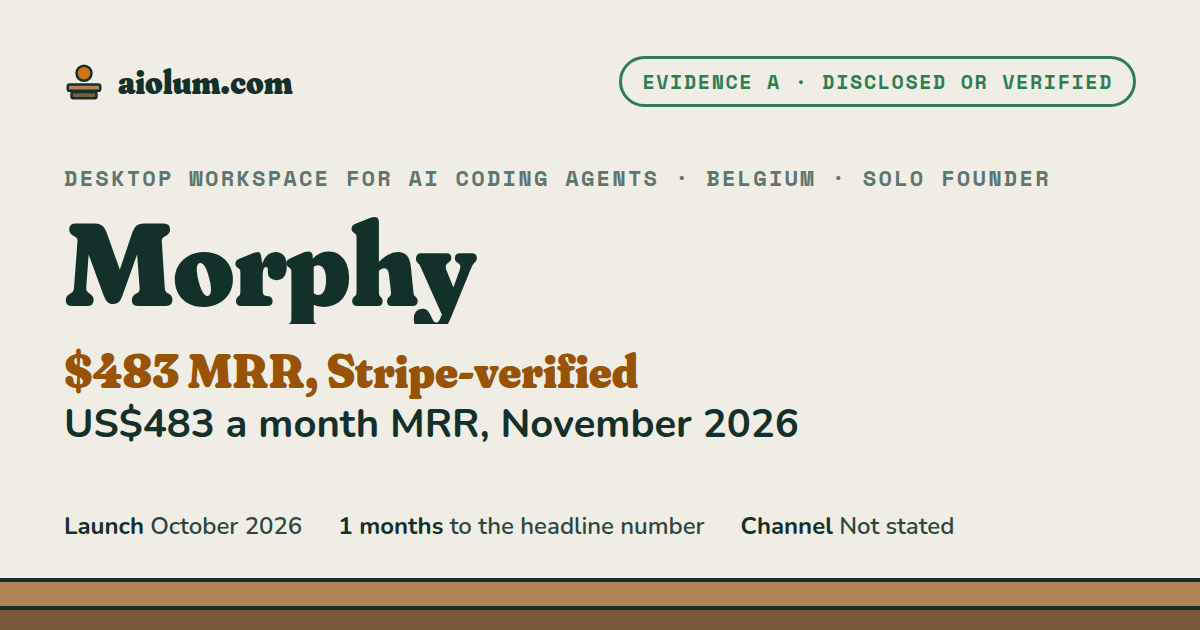
Morphy (Desktop workspace for AI coding agents, Belgium): US$483 a month MRR, November 2026. Evidence grade A: disclosed by a company or a filing, or verified by a payment processor. Team: 1 named maker; the home page also credits 23 builders from the Discord community. Launched October 2026; still running.Added
- Outcome
- US$483 a month MRR, November 2026
- Evidence
- A disclosed by a company or a filing, or verified by a payment processor
- Launch
- October 2026
- Status
- Still running
- Team
- 1 named maker; the home page also credits 23 builders from the Discord community
- Outside funding
- None stated
- Main channel
- Not stated
Morphy is a desktop workspace for coding agents, programs in which an AI model reads and changes the files of a software project on request. Its home page shows several agents at work on one canvas, a zoomable surface where chats, cards, browsers and terminals sit side by side. The terms of service say that Casper Apers makes Morphy in Antwerp, Belgium.
Morphy has a free plan and a paid plan called Pro. The terms and the pricing page give Pro at US$9 a month or US$90 a year. TrustMRR is a revenue directory that reads the payment records of a company through an API key. On 10 November 2026 it showed a verified monthly recurring revenue (MRR, the subscription income that repeats each month) of US$483, from 68 active subscriptions.
The headline figure comes from the Stripe payment records that TrustMRR reads, so it has grade A. The record is short: TrustMRR lists the company as founded on 9 October 2026, and its verified revenue is US$1,055 in total. The profile text and the home page counters are written by the company and are not verified.
Why did Morphy work?
Four causes, in the order they mattered. Each one is a reusable lesson.
It targets developers who run several coding agents
The company's pages describe one audience and one problem. The home page promises one canvas for all agents and projects. The TrustMRR profile, written by the company, names the problem as juggling Claude Code, Codex and other agents across terminals and windows.
The paid plan carries no AI usage, so customers pay providers directly
The terms say that Morphy plans do not include any AI usage. Customers connect their own accounts with providers such as Claude or ChatGPT. The privacy policy adds that chat messages go from the customer's computer to the chosen provider. One Pro feature is an exception. The privacy policy says dictated text is sent to Morphy's server and on to OpenRouter for cleaning up.
A free plan with limits sits next to a paid plan without them
Freemium allows 3 agents at a time, 2 projects and 3 cards. Pro removes those limits and adds features such as scheduled messages and a phone view. The pricing page says a friend with Pro can share an invite link that gives one free week of Pro.
A creator program pays 50% of each payment for life
The creators page offers video makers 50% of every payment from a customer they bring, for as long as that customer pays. Their viewers get 20% off Pro for 3 months. No source shows how many customers this program has brought.
How it was built
These details come from the company's TrustMRR profile, which it wrote, and from its own pages. They are grade C unless noted. [1, 6, 2, 4]
- The profile lists Electron and Next.js for the front end, and Node.js, MongoDB, Vercel and Stripe for the back end.
- The privacy policy names Vercel as the host of the site, Resend as the email provider, and PayPal or Wise for creator payouts.
- Prompts go from the customer's computer to the AI provider the customer chose, the home page says. Files and chats stay on the computer.
- Pro is paid through Stripe, which handles card details, the terms say.
- The profile lists Instagram, TikTok, Discord and YouTube as marketing channels. No source says which of them brought customers.
Who tried this before Morphy, and why did they fail?
Four companies in our database of failed startups built developer tools that failed to earn enough from developers. The values below are from that database and are not independently verified.
Fig DevTool
The promiseAutocomplete and visual command builders inside the terminal.
Why it diedThe record says the failure was a unit economics and monetization problem. Developers had low willingness to pay for terminal improvements.
Kite DevTool
The promiseAI code completion inside the editor.
Why it diedThe record calls it a case of being too early to a market that later grew, with missteps in monetization.
Nitrous.io
The promiseA cloud development environment that removed local setup.
Why it diedThe record says it was squeezed by fatal competition and wrong timing in cloud development environments.
CodeSee
The promiseInteractive maps of a codebase for faster onboarding.
Why it diedThe record says the main cause was a gap between perceived value and willingness to pay. Its free plan drew users with no budget, and it ended in 2024.
The failed startups come from our database of 1,749 dead startups, retold here in our own words. Its entries are AI-assisted summaries of public sources, so these cards carry no evidence grade.
What changed
All four sold a developer tool for which free alternatives existed. The records say developers paid little for improvements to the terminal, the editor or the codebase map.
Morphy differs in what it sits on top of. It is a workspace around coding agents that customers already pay for. Its Pro plan costs US$9 a month, and the terms say plans include no AI usage. The customer pays the AI provider for the agents' usage. After about a month, no source shows whether customers keep paying.
Can one person copy Morphy now?
The structure can be copied. The timing is a one-time opening.
A workspace for several coding agents has a clear job and a low price. The customers pay the AI providers for the agents' usage. The record is only about a month long, so the method is not proven over time.
Where it is still open: Other tools that need a control surface around agents: review, scheduling, monitoring and handing work from one agent to the next.
- 1Pick the work that a new class of tool creates, here running several coding agents at once.
- 2Let customers bring their own AI accounts, so the plan contains no usage cost.
- 3Offer a free plan with limits and a low monthly price for the limits removed.
- 4Verify revenue through a payment-processor connection, so a reader can check it.
How much revenue does Morphy make?
Each row shows the evidence grade and the source numbers from the list at the end of this page. The grades are explained in How Aiolum verifies.
| Fact | Value | Grade | How we know | Sources |
|---|---|---|---|---|
| Monthly recurring revenue, 10 November 2026 | US$483 | A | TrustMRR snapshot, read from Stripe through an API key. Revenue last synced 10 November 2026. | [1] |
| Annual run rate from that MRR | US$5,796 a year | calc | Calculated: US$483 times 12. | [1] |
| Verified revenue in the last 30 days | US$1,050 | A | TrustMRR, last synced 10 November 2026. It is not the same as MRR, because it counts every payment in the period. | [1] |
| Verified revenue in total | US$1,055 | A | TrustMRR, last synced 10 November 2026. The monthly table shows US$889 for October 2026 and US$166 for November 2026 up to the sync. | [1] |
| Active subscriptions, 10 November 2026 | 68 | A | TrustMRR snapshot from Stripe. | [1] |
| Company start | 9 October 2026 | C | The founded date on the TrustMRR profile, which the company wrote. An archived copy of the home page from 4 October 2026 already shows a free beta for Windows. | [1, 7] |
| Team | 1 named maker | C | The terms say Casper Apers makes Morphy. The home page also credits 23 builders from the Discord community, who are not described as staff. | [4, 2] |
| Country | Belgium | C | TrustMRR lists country BE. The terms say the maker is in Antwerp, Belgium, and list a Belgian enterprise number. The register was not checked. | [1, 4] |
| Pro price | US$9 a month or US$90 a year | C | Terms, last updated 28 October 2026, and the pricing page. A subscriber who got Pro before 20 October 2026 pays US$5 a month, the terms say. | [4, 3] |
| Lifetime Pro price | US$299 once | C | Lifetime page. The terms say US$99 for the first 5 people, US$299 after that. | [8, 4] |
| Free plan | no time limit | C | The pricing page says Freemium is free for good, with no card and no clock running. | [3] |
| Outside funding | none found | C | No source names an investor. Nothing was found that rules one out. | [1, 2] |
| Estimated users | 700 | C | The company wrote this on its TrustMRR profile as an estimate. It is not verified. | [1] |
| Time from start to the November 2026 figure | 1 month | calc | Calculated: 9 October 2026 to 10 November 2026. | [1] |
How to read this table. Grade A values are read by TrustMRR from the payment records at Stripe. Grade C values are statements on the company's own pages or in the profile text that the company wrote. A "calc" value was computed on this page.
| Plan | Per month, billed yearly (US$) | Per month, billed monthly (US$) | Limit |
|---|---|---|---|
| Freemium | 0 | 0 | 3 agents at a time, 2 projects, 3 cards of your own |
| Pro | 7.5 | 9 | no limits on agents, projects and cards |
| Lifetime Pro | 299 one-time | Pro for as long as Morphy offers Pro; US$99 for the first 5 people |
Prices are in US dollars and include VAT, as the pricing page states. The yearly price is US$90, which is US$7.50 a month. The lifetime page shows US$299 once. The terms say Lifetime Pro cost US$99 for the first 5 people. Morphy plans carry no AI usage; the customer pays the AI provider separately.
When did Morphy launch, and how did it grow?
From a free Windows beta in early October 2026 to a paid product with 68 active subscriptions on 10 November 2026. Each entry carries its grade.
- 4 October 2026CAn archived copy of the home page offers a Windows app that is free during beta. It says a Mac version is on the way. [7]
- 9 October 2026CThe TrustMRR profile lists this date as the founding of the company. [1]
- Before 20 October 2026CPro is sold at US$5 a month. The terms say subscribers from that period keep that price. [4]
- October 2026ATrustMRR shows US$889 of verified revenue for the month. [1]
- 26 October 2026CThe creator program terms are last updated. They offer creators 50% of each payment of the customers they bring. [5]
- 28 October 2026CThe terms are last updated, with Pro at US$9 a month or US$90 a year. [4]
- 10 November 2026ATrustMRR syncs US$1,055 of total revenue, US$483 of MRR and 68 active subscriptions. [1]
What could go wrong for Morphy?
The risks are the mirror image of the causes above.
A very short record
The company is about five weeks old. TrustMRR shows US$1,055 of verified revenue in total, so a trend cannot be read yet. The trend field is set to unknown for that reason.
Testimonials and counters on the home page
The home page shows five-star testimonials signed with user names or handles and no links. It also shows a count of 23 builders from the Discord and the figure 17 next to Community. The profile text mentions 1,300 or more builders in the Discord. No source verifies these counts.
Creator program
The creators page offers 50% of each payment for life and states that creators must mark videos as ads and must not post fake reviews. It states no earnings claim. At the time of reading it said only 8 spots were left, a count that nothing verifies.
Prices have changed within weeks
The terms say Pro cost US$5 a month before 20 October 2026 and that subscribers keep their price. Lifetime Pro cost US$99 for the first 5 people and costs US$299 on the lifetime page now. The profile text still lists US$14 for Pro after the limited spots, which differs from the US$9 on the pricing page.
Dependence on other companies' agents
Morphy runs on the accounts of providers such as Anthropic and OpenAI. The terms say their own terms and prices apply. A change by a provider could change what Morphy can do.
Free side tools and a view count
The site has a free design extractor that reads the colours, fonts and spacing of any website a visitor pastes. Its page says to keep the look and not the content. The free video skills page shows a claim of 4.8 million views in 11 days, which no source verifies.
Sources
The grade next to each source is the best grade that the source can support. "Read in full" means that the text of the page was downloaded and the numbers were checked in it.
- A TrustMRR profile of Morphy, markdown version, read 11 November 2026Read in full. The revenue, MRR and subscription figures come from Stripe. The description and the other profile text are written by the company.
- C Morphy home page, read 11 November 2026Read in full. Source for the product, the plans, the testimonials, the counters and the credit line.
- C Morphy pricing page, read 11 November 2026Read in full. Source for the Pro price and the plan limits.
- C Morphy terms, last updated 28 October 2026Read in full. Source for the maker, the prices, the earlier price and the lifetime price.
- C Morphy creator program page, creator terms last updated 26 October 2026Read in full. Source for the commission, the discount and the rules for creators.
- C Morphy privacy policy, last updated 6 November 2026Read the sections on payments, email, hosting and where chat messages go.
- C Internet Archive copy of the Morphy home page, 4 October 2026Read in full. Shows the free Windows beta before the TrustMRR founded date.
- C Morphy lifetime page, read 11 November 2026Read the price line. It shows US$299 once.
- C Database of failed startups, local exportRecord pages read on the website on the day of writing. AI-written summaries, not independently verified. Source for the failed predecessors.
Run this company? Send corrections or a verified figure to aiolum@livyden.com