Oleve (Quizard AI and Unstuck AI): Revenue, team and how it was built
Oleve (Quizard AI and Unstuck AI) (Portfolio of consumer AI study apps: a photo homework solver and a lecture note taker, United States): US$6M a year run rate, June 2025. Evidence grade C: the founder's own figures, not verified by anyone else. Team: 3 co-founders from a college dorm room in 2023; 4 people at the US$6M figure in June 2025 by the founder's talk, 6 by Latka's July 2025 interview; 9 employees in Latka's database by August 2026. Launched 26 January 2023; still running.Added 5 November 2026
- Outcome
- US$6M a year run rate, June 2025
- Evidence
- C the founder's own figures, not verified by anyone else
- Launch
- 26 January 2023
- Status
- Still running
- Team
- 3 co-founders from a college dorm room in 2023; 4 people at the US$6M figure in June 2025 by the founder's talk, 6 by Latka's July 2025 interview; 9 employees in Latka's database by August 2026
- Outside funding
- Neo accelerator and an angel round, amount not published by the company (the Lean AI Leaderboard lists US$600,000 in total, grade D)
- Group
- Learning and study
- Main channel
- Creators and short videos
Oleve is a small New York company that builds consumer apps, programs sold directly to individuals through the app stores, with a large language model inside. Its first app, Quizard AI, reads a photographed homework or test question and returns an answer with an explanation. Its second, Unstuck AI, turns recorded lectures and course files into notes, flashcards and quizzes. Both are paid by subscription, a payment that renews every week or every year until the user cancels.
Michael Giardino, Sidhant (Sid) Bendre and Achraf Golli launched Quizard from a University of Rochester dorm room on 26 January 2023. A TikTok video with the hook "ChatGPT and Photomath had a baby" brought about 10,000 users in under 30 hours. After graduating they moved to New York, joined the Neo accelerator, and, by Bendre's account, reached US$1 million in annual recurring revenue (ARR, the yearly value of the subscriptions active at one moment) and profitability within nine months. In June 2025, on stage at the AI Engineer World's Fair, Bendre said Oleve made US$6 million in ARR, profitably, with four people. In a July 2025 Latka interview he gave the same US$6 million, about US$500,000 a month, with six people.
Every revenue figure on this page comes from the founder, grade C; the numbers agree across February, June and July 2025, but no payment processor or filing confirms them. The company is named on the page because the business is the whole portfolio: one of its two apps, Quizard, is a homework solver sold to students, which some readers will see as academic help that can be used to cheat. That is described neutrally under "Things to watch".
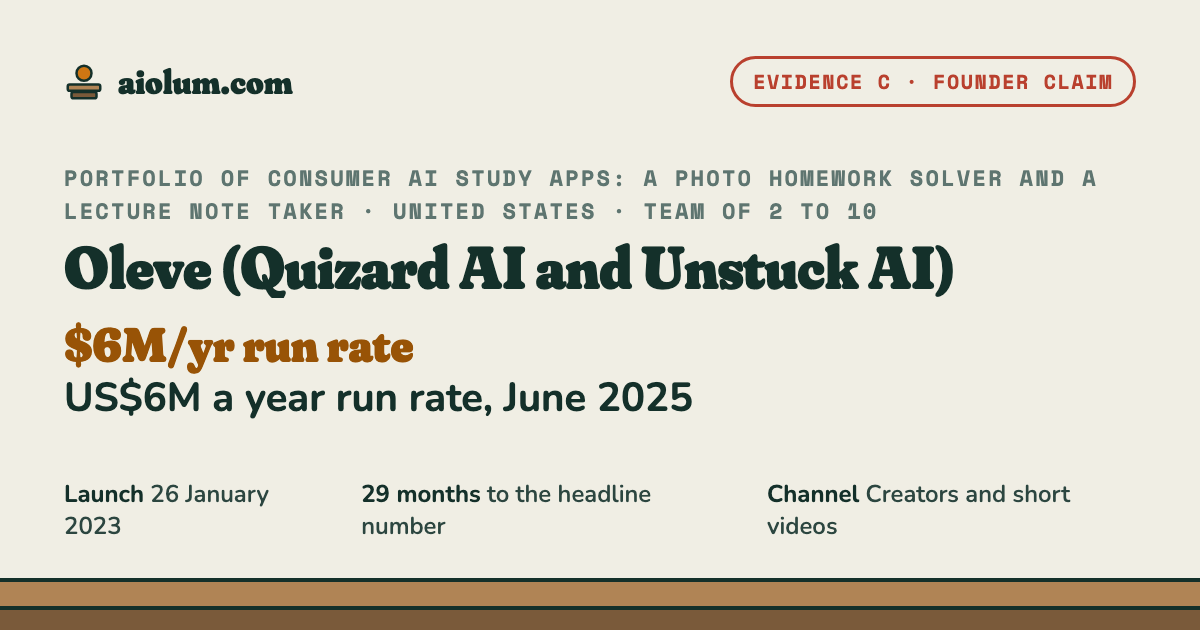
How much revenue does Oleve (Quizard AI and Unstuck AI) make?
Each row shows the evidence grade and the source numbers from the list at the end of this page. The grades are explained in How Aiolum verifies.
| Fact | Value | Grade | How we know | Sources |
|---|---|---|---|---|
| Annual recurring revenue, June 2025 | US$6 million | C | Sid Bendre's talk "The New Lean Startup" at the AI Engineer World's Fair, 3 to 5 June 2025, as written up by AI Engineer: "Oleve reached $6 million in annual recurring revenue, operated profitably, and generated more than half a billion social media views with four people." | [1, 3, 13] |
| Revenue per month, July 2025 | about US$500,000 | C | Bendre on the Latka podcast, episode published 15 July 2025, as summarized by Latka's blog. The same summary gives US$6 million ARR. | [2] |
| Monthly revenue times 12 | US$6 million a year | calc | Calculated: US$500,000 times 12 is US$6,000,000, so the July 2025 monthly figure agrees with the June 2025 ARR. | [2] |
| Revenue listed in February 2025 | US$6 million a year, 4 employees, profitable | D | Lean AI Leaderboard row with snapshot "Feb 2025", which cites a LinkedIn post that this page could not read. Read in the published leaderboard sheet on 5 November 2026. | [12] |
| First US$1 million ARR | within nine months, with profitability | C | Bendre's talk: "Oleve reached its first $1 million ARR and profitability within nine months of operating." The talk does not give the month. | [1, 3] |
| Profit margin, mid-2025 | 10% to 30% | C | Latka's episode notes, as quoted by Latka's blog. Startup Spells, July 2025, gives 20% to 30%. A wide, self-reported band. | [2, 4] |
| Revenue per person, mid-2025 | US$1.5 million with 4 people; US$1 million with 6 | calc | Calculated: US$6,000,000 divided by 4 and by 6. The two headcounts come from two sources (see the team row). | [1, 2] |
| Team at the US$6 million figure | 4 people (June 2025 talk) or 6 (July 2025 interview) | C | The talk write-up says "four people"; Latka's blog says "a team of six". Startup Spells uses both numbers in one article. The founding team was three co-founders. | [1, 2, 4] |
| Team in August 2026 | 9 employees | D | Latka's company database, last update 10 August 2026, as reported on Latka's blog. Quizard's own About page shows nine people, including interns. | [2, 6] |
| Launch of Quizard AI | 26 January 2023, from a college dorm room | C | Talk write-up gives the date. Quizard's About page: "Quizard was launched from our college dorm room in January 2023." | [1, 6] |
| First viral video | about 10,000 users in under 30 hours | C | Bendre's account. The talk write-up says one million views; Latka's blog and Startup Spells say about 2.3 million views overnight. | [1, 2, 4] |
| Funding | Neo accelerator and angel investors; amount not published by the company | C | Quizard's About page: "backed by world-class investors such as Neo" and several named angels. The Lean AI Leaderboard lists US$600,000 total funding and a US$10 million valuation (grade D, one source). | [6, 12] |
| Quizard ratings | 59,000 ratings, 4.7 stars, age rating 4+ | C | App Store page read on 5 November 2026. Seller: Quizard AI, Inc. The home page claims 2,000,000+ students and 50,000,000+ questions answered. | [7, 8] |
| Unstuck ratings | 2,700 ratings, 4.7 stars, age rating 4+ | C | App Store page read on 5 November 2026, same seller. The home page says "Trusted by 2M+ students". | [9, 10] |
| Unstuck early growth | 1 million users in under 9 weeks, or 8 million | C | The talk write-up says one million users in under nine weeks; Startup Spells says 8 million users in 9 weeks. Latka's blog flags the conflict and endorses neither. | [1, 2, 4] |
| Downloads across the portfolio | about 4 million (mid-2025); more than 8 million (2025 retrospective) | C | Latka's blog for the mid-2025 figure; AI Engineer's Oleve page for Bendre's 2025 retrospective. | [2, 5] |
| Third product | outside education, built in three weeks, more than 1,000 users | C | Bendre's talk, June 2025. Its name was not public then and this page could not identify it. | [1] |
| Time from launch to the June 2025 figure | 29 months | calc | Calculated: January 2023 to June 2025. | [1] |
How to read this table: a grade C value is a statement by the founder (a conference talk, an interview) or by the company's own pages. A grade D value is a third-party list or estimate with no second source. A "calc" value was computed on this page. No value is grade A or B.
| Plan | Per month, billed yearly (US$) | Per month, billed monthly (US$) | Limit |
|---|---|---|---|
| Quizard, Unlimited answers weekly | 6.99 a week or 9.99 a week | unlimited answers | |
| Quizard Pro, monthly | 17.99 or 19.99 | Pro features | |
| Quizard Pro, 6 months | 6.67 | 39.99 every 6 months | |
| Quizard Pro, yearly | 2.50 to 6.67 | 29.99, 39.99, 59.99, 69.99 or 79.99 a year | |
| Unstuck, weekly subscription | 9.99 a week | Pro features | |
| Unstuck, yearly | 6.67 | 79.99 a year; Unstuck Pro also listed at 99.99 and 129.99 | |
| Unstuck Pro, other listed prices | 9.99 or 19.99 | period not shown on the store page |
The App Store lists several prices for the same plan, which matches the founder's account of constant paywall price tests. Weekly plans are shown as "a week". Yearly plans are shown per month (the yearly price divided by 12). Users pay through Apple; Oleve's reply to a refund request on the Quizard page says Apple manages all billing.
When did Oleve (Quizard AI and Unstuck AI) launch, and how did it grow?
From a viral TikTok video in a college dorm room to a four-person, US$6 million portfolio in 29 months. Each entry carries its grade.
- 26 January 2023CQuizard AI launches from a University of Rochester dorm room with a TikTok video that goes viral overnight; about 10,000 users in under 30 hours. [1, 6]
- Early 2023CThe free beta runs on OpenAI's Codex model through several accounts; the team moves to GPT-3.5 when Codex is shut down in March 2023. A weekly subscription follows within weeks. [1, 4]
- Fall 2023CAfter graduating, the founders move to New York, join the Neo accelerator and run a back-to-school campaign of street interviews at US colleges. [1, 4]
- Within nine monthsCBy Bendre's account, US$1 million ARR and profitability. [1, 3]
- Spring 2024CA second campaign takes Quizard to number six in an education chart, by Bendre's report. [1]
- After spring 2024CUnstuck AI, a study app, launches and reaches one million users in under nine weeks by Bendre's account. Startup Spells dates the launch to August 2023 instead; the sources disagree. [1, 4]
- February 2025DThe Lean AI Leaderboard lists Oleve at US$6 million revenue with 4 employees. [12]
- 3 to 5 June 2025CBendre tells the AI Engineer World's Fair that Oleve makes US$6 million ARR, profitably, with four people, and has a third product outside education. [1, 13]
- 15 July 2025CThe Latka podcast publishes Bendre's interview: US$6 million ARR, about US$500,000 a month, six people. [2]
- 2025CThe business rebrands from Quizard to Oleve. [5]
- August 2026DLatka's database still lists US$6 million revenue, now with nine employees. [2]
Why did Oleve (Quizard AI and Unstuck AI) work?
Four causes, in the order they mattered. Each one is a reusable lesson.
Short videos first
Each app starts with a planned TikTok campaign: a hook video for Quizard, street interviews at colleges, then handwritten sticky notes and trending sounds for Unstuck. Bendre reports more than 250 million social views for Unstuck in one month. Paid acquisition is small by the founders' account.
Weekly price, paywall at sign-up
The founders tried a free app with paid queue-skipping, then coins and credits. The version that worked was a weekly subscription around US$9.99, shown at sign-up. Several prices for the same plan on the App Store pages show that the tests continue.
Reuse everything
Model integrations, experiment tools, notification code and product templates move from one app to the next. Bendre says the third product took three weeks to build because of this prepared code.
Few people, clear ownership
Product engineers ("harvesters") each own one app's metrics and experiments; platform engineers ("cultivators") build shared automation. The company prefers an empty seat to a weaker hire and uses AI tools for scripts, campaign analysis and code.
How it was built
These details come from Bendre's talk, his interviews as summarized by Latka and Startup Spells, and the App Store pages. They are grade C. [1, 4, 2, 7, 8]
- The first backend used Python, Flask, Notion and Excel, with completions from OpenAI's Codex and GPT models routed through ten API keys.
- Azure credits of US$2,000 grew to more than US$300,000, by Startup Spells' account; LaunchDarkly feature flags spread requests across several Azure OpenAI endpoints when quotas were tight.
- Unstuck passes uploaded files through a chain of outside document-ingestion services, and operators can change the order in LaunchDarkly when one fails.
- Paywall and onboarding experiments run on Superwall, with Mixpanel for analytics; six or seven A/B tests run at once on the main app, by Latka's summary.
- TRELLIS, the team's own method: group real user requests into intents, build a fixed workflow for each, and fix failures one workflow at a time.
- Both apps are sold on iPhone through Apple's in-app purchases; Quizard is also on Google Play and the Chrome Web Store.
Tools named in the sources
Each one opens its page in the Tools tab, with every story that uses it.
Who tried this before Oleve (Quizard AI and Unstuck AI), and why did they fail?
Five companies in our database of failed startups sold study help to students and failed. The values below are from that database and are not independently verified.
MathChat
The promiseA mobile app where students solve math problems together.
Why it diedIt bet on viral student growth without teachers, while broader chat tools took the niche.
Flashnotes
The promiseA marketplace where college students sell their notes and study guides.
Why it diedCourse Hero and Chegg offered more, with better products and more money; note quality was uneven.
Tutorspree
The promiseFind and hire a good tutor online.
Why it diedNot enough tutors and students in each place for the marketplace to work.
Grockit
The promiseSocial, game-like test preparation for the SAT, GMAT and similar exams.
Why it diedLive group study was costly per user, and free platforms copied the ideas.
Kno
The promiseInteractive digital textbooks for students.
Why it diedThe big publishers made their own digital books faster and cheaper.
The failed startups come from our database of 1,749 dead startups, retold here in our own words. Its entries are AI-assisted summaries of public sources, so these cards carry no evidence grade.
What changed
The predecessors sold study help through marketplaces, schools or publishers, and each needed many people or partners before a student got value: tutors, note sellers, teachers, content licenses. Viral growth among students came and went with the school year.
Quizard and Unstuck need no second side. A language model answers the question or writes the flashcards, so one app serves the student alone, and a weekly price matches the way students use it, around tests. The founders also treated short-video distribution as a repeatable system rather than luck. The risk that remains is the one MathChat met: student attention is seasonal, and large companies sell the same answer apps (the founders name Photomath, Gauth and Question.AI as competitors).
Can one person copy Oleve (Quizard AI and Unstuck AI) now?
The first wave, no. The method, partly.
A photo-answer app in January 2023 was early; today the education charts are full of them, several owned by large companies. What one person can copy is the method: a short-video campaign planned before launch, a weekly paywall tested from day one, and shared code that makes each new app cheaper than the last.
Where it is still open: Study tools that help learning rather than give answers (lecture notes, spaced-repetition flashcards, practice quizzes), and the same playbook outside education, which Oleve itself said it was trying in 2025.
- 1Pick a job that students or another group repeat every week, and price it weekly.
- 2Plan the launch video and its hook before writing the app.
- 3Build experiments for paywall and onboarding into the first version.
- 4Keep model access, analytics and paywall code in a shared library so the next app takes weeks, not months.
What could go wrong for Oleve (Quizard AI and Unstuck AI)?
The risks are the mirror image of the causes above.
Founder-reported, two headcounts
The US$6 million figure is Sid Bendre's own, given on stage in June 2025 and in an interview in July 2025, and listed by the Lean AI Leaderboard from a LinkedIn post in February 2025. No payment processor, filing or buyer confirms it. The team at that figure is four people in the talk and six in the interview; Latka's database showed nine employees in August 2026.
Quizard is a homework solver sold to students
The App Store page calls Quizard a "Homework & AI Answers Solver" and says students can "prepare for quizzes, tests, and exams, allowing you to confidently ace them"; the home page says "Take a picture, get an answer." The listing names high school as well as college students, and the age rating is 4+. Schools may treat submitted AI answers as cheating; the company's pages do not discuss this. Unstuck, the second app, makes notes and quizzes from the student's own course material.
Early model access and marketing tactics
By Bendre's account in the talk, the free beta in early 2023 ran on OpenAI's Codex through ten friends' accounts, to avoid model charges. Startup Spells, summarizing his interviews, says the company's internal "creator agents" source influencers and generate "UGC-style campaigns". The sources do not say whether paid creators are disclosed as paid.
Conflicting growth numbers
Unstuck's early users are one million in nine weeks in one source and eight million in another, and its launch is dated August 2023 in one source and after spring 2024 in another. The Unstuck App Store number (id6714484560) and its 2,700 ratings do not settle either question.
Crowded market and seasonal demand
Photo-answer apps from TikTok's owner (Gauth), Google (Photomath) and Zuoyebang (Question.AI) compete for the same students. Bendre's own words in Startup Spells accept churn: "It's okay if someone uninstalls. We want them to remember the name."
Sources
The grade next to each source is the best grade that the source can support. "Read in full" means that the text of the page was downloaded and the numbers were checked in it.
- C AI Engineer: The New Lean Startup, talk by Sid Bendre at the AI Engineer World's Fair 2025, with written versionRead in full (the written version of the talk). Source for the US$6 million ARR with four people, the launch date, the first US$1 million, the chart positions and the team structure.
- C Latka blog: Oleve Revenue: Inside the $6M ARR Studio Behind Quizard AI, by Nathan Latka (16 June 2025, updated 31 August 2026)Read in full. Summarizes Bendre's Latka podcast episode of 15 July 2025: US$500,000 a month, six people, margins, pricing history, tools; and Latka's August 2026 database entry.
- C AI Engineer: Sid Bendre speaker pageRead in full. Biography; confirms the US$1 million ARR in nine months and the four-person, US$6 million company at the 2025 World's Fair.
- C Startup Spells: How Oleve Built a $6M ARR AI Empire w/ 4 employees from a Homework App (30 July 2025)Read the section on Oleve. A newsletter summary of Bendre's Latent Space and Latka interviews; source for the early stack, Azure credits, Unstuck campaign and angel investors.
- C AI Engineer: Oleve organization pageRead in full. Ties Quizard and Unstuck to Oleve, names the three co-founders, the 2025 rebrand and the 8 million downloads in Bendre's 2025 retrospective.
- C Quizard AI: About QuizardRead in full. Company page: dorm-room launch in January 2023, NYC team, Neo and angel backing, team list.
- C Quizard AI home pageRead in full. Product claims, student and question counts, store links.
- C App Store: Quizard AI: Homework HelperRead in full on 5 November 2026. Description, ratings, age rating, seller and in-app purchase prices.
- C Unstuck AI home pageRead in full. Features and user claim.
- C App Store: Unstuck AI Note TakerRead in full on 5 November 2026. Description, ratings, seller and in-app purchase prices.
- C Oleve home pageThe page loads its text by script; read the text in its page script: "a small, focused team in NYC" with "two products already serving millions of users".
- D Lean AI Leaderboard (published sheet, row for Oleve)Read the row for Oleve in the leaderboard's published CSV, downloaded 5 November 2026. It cites a LinkedIn post that this page could not open.
- C AI Engineer World's Fair 2025 event pageRead the section with the dates: 3 to 5 June 2025, San Francisco.
- C Database of failed startups, local exportLocal export. AI-written summaries, not independently verified. Source for the failed predecessors.
Run this company? Send corrections or a verified figure to aiolum@livyden.com