Pencil (now pen.dev): Product, team and how it was built
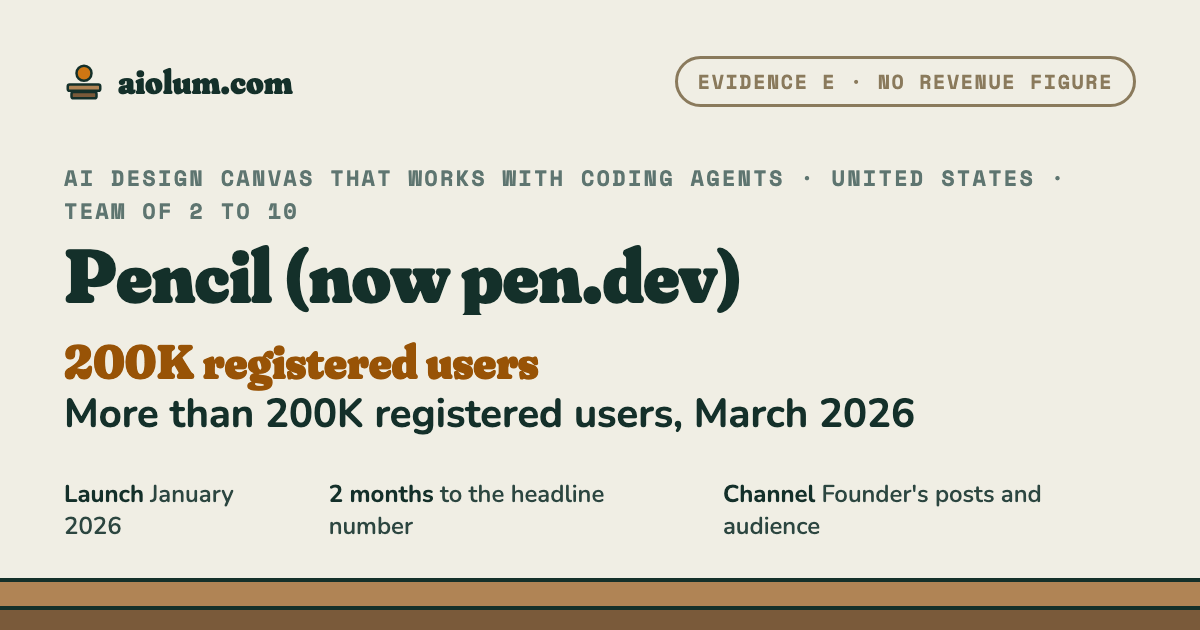
Pencil (now pen.dev) (AI design canvas that works with coding agents, United States): More than 200K registered users, March 2026. Evidence grade E: no revenue figure was checked. Team: Started by founder Tom Krcha as his own side project in 2025; a ten-person team in March 2026 after a16z speedrun funding. Launched January 2026; still running, revenue growing.Added 6 November 2026
- Outcome
- More than 200K registered users, March 2026Revenue growing
- Evidence
- E no revenue figure was checked
- Launch
- January 2026
- Status
- Still running
- Team
- Started by founder Tom Krcha as his own side project in 2025; a ten-person team in March 2026 after a16z speedrun funding
- Outside funding
- a16z speedrun and Kaya VC, amount not disclosed
- Main channel
- Founder's posts and audience
What is not verified
No revenue figure was found: no payment-processor profile, no filing and no founder statement of revenue. The user counts (100,000 on 24 February 2026, more than 200,000 registered users in March 2026) are the founder's own words in a post and one interview, and registered users are not paying users. A reader could look for a disclosed funding round or a revenue figure in a later interview. This story is grade E: the business is real and its product, price and customers are described from public pages, but no revenue figure was checked. Aiolum shows it as an idea worth studying, not as proof that it makes money.
Pencil, renamed pen.dev in 2026, is a design canvas, a drawing surface for screens and layouts like Figma, on which AI agents draw designs as editable layers. It connects to coding agents through MCP (Model Context Protocol), an open standard that lets an AI agent call the tools of another program. So Claude Code or Cursor can read a design file and write the matching code, and the design file lives next to the code in the same project.
Tom Krcha, who worked for Adobe in San Francisco and was head of product at Around, a startup that Miro bought, built the first version for himself while coding with Cursor. After a closed beta with several hundred users it opened to the public in January 2026. He posted on X on 24 February 2026 that Pencil had crossed 100,000 users, and he told CzechCrunch in March 2026 that it had more than 200,000 registered users and a team of ten.
No revenue figure was found. The company has paid plans, raised money from the a16z speedrun accelerator and the Czech fund Kaya VC without disclosing the amount, and grew past a solo start. Every user count on this page is the founder's own statement.
How much revenue does Pencil (now pen.dev) make?
Each row shows the evidence grade and the source numbers from the list at the end of this page. The grades are explained in How Aiolum verifies.
| Fact | Value | Grade | How we know | Sources |
|---|---|---|---|---|
| Registered users, March 2026 | more than 200,000 | D | Founder in an interview with CzechCrunch, 24 March 2026: 'Aktuálně je jich více než dvě stě tisíc' ('Currently there are more than two hundred thousand of them', translation). | [1] |
| Users, 24 February 2026 | 100,000 | D | Founder's post on X, 'Pencil just crossed 100,000 users!', dated 24 February 2026, as quoted by CzechCrunch and the a16z speedrun newsletter. The newsletter dates the milestone to May; the post itself is dated February. | [1, 2] |
| Public launch | January 2026, after a closed beta with several hundred users | D | Founder to CzechCrunch: a closed beta 'do letošního ledna' ('until this January', translation), and 'necelé dva měsíce' ('not quite two months', translation) public on 24 March 2026. | [1] |
| Founding | built by Tom Krcha for his own use while coding in Cursor | D | CzechCrunch: 'Když už si takový nástroj postavil' ('Once he had built such a tool', translation). The podcast episode calls it a side project. No source names a co-founder. | [1, 3] |
| Team, March 2026 | ten people | D | CzechCrunch: 'Desetičlenný tým' ('the ten-member team', translation). The careers page listed one open role on 6 November 2026. | [1, 6] |
| Funding | a16z speedrun cohort SR005 and Kaya VC; amount not disclosed | D | Founder to CzechCrunch, who said he would not name the amount and that a further round was open. The home page says 'Backed by a16z speedrun'. | [1, 2, 4] |
| Prices | Free; Pro US$16 and Ultra US$48 per user per month billed annually | C | Company pricing page, 6 November 2026. | [5] |
| AI models | Claude, ChatGPT, Gemini, Grok, Qwen, Kimi, DeepSeek, MiniMax; hosted DeepSeek and GLM | C | Home page and pricing FAQ. Users can bring their own subscription or API key. | [4, 5] |
| Parallel agents | up to 6 agents on one canvas (Swarm mode) | C | Pricing page: Free 1, Pro up to 3, Ultra up to 6. Swarm mode was announced with the 100,000-user post. | [5, 2] |
| Company and name | High Agency Inc.; pencil.dev is now pen.dev | C | Footer and banner of the home page, 6 November 2026. | [4] |
| Time from public launch to 200,000 users | about 2 months | calc | Calculated: January 2026 to March 2026. | [1] |
How to read this table: a grade D value is a founder statement given in one interview or one post, not checked by anyone else. A grade C value is the company's own page read on 6 November 2026. A "calc" value was computed on this page. No revenue figure exists in the sources.
| Plan | Per month, billed yearly (US$) | Per month, billed monthly (US$) | Limit |
|---|---|---|---|
| Free | 0 | 0 | 5 days a month with an agent, 25 image and SVG generations, 1 agent at a time |
| Pro | 16 | per user; 350 generations, up to 3 agents in parallel, hosted model credits | |
| Ultra | 48 | per user; 750 generations, up to 6 agents in parallel, shared team usage | |
| Enterprise | custom | contact sales |
The page shows annual prices by default and says monthly billing costs 20% more; the monthly figures load by script and were not in the downloaded page, so that column is empty. Every plan can use the customer's own Claude or ChatGPT subscription or API key; the included credits are for models that pen.dev hosts itself.
When did Pencil (now pen.dev) launch, and how did it grow?
From a tool the founder built for his own coding work to a public product with a ten-person team, in about a year. Each entry carries its grade.
- 2025DTom Krcha builds a tool to draw user interfaces for the AI coding tool Cursor instead of describing them in text. A demo video on X and LinkedIn passes one million views, he told CzechCrunch. [1, 3]
- 2025DPencil joins the a16z speedrun accelerator as part of cohort SR005; speedrun and Kaya VC invest an undisclosed amount. [1, 2]
- January 2026DEnd of the closed beta with several hundred users; public launch. [1]
- 24 February 2026DThe founder posts that Pencil has crossed 100,000 users and introduces Swarm mode, several AI design agents working in parallel. [1, 2]
- 24 March 2026DHe tells CzechCrunch that Pencil has more than 200,000 registered users and a team of ten. [1]
- 6 November 2026CThe product runs as pen.dev with Free, Pro and Ultra plans and desktop, web, VS Code, Cursor and command-line versions. [4, 5]
Why did Pencil (now pen.dev) work?
Four causes, in the order they mattered. Each one is a reusable lesson.
A design file that agents can read
A .pen file is JSON with an open schema. A coding agent does not need to interpret a picture: it reads the layers, sizes and colors directly, through MCP or the command-line tool, and writes code from them.
Bring your own model
The canvas works with the Claude or ChatGPT subscription or API key the user already has. Hosted models (DeepSeek and GLM) are sold as credits in the paid plans for users without their own key.
Several agents at once
Swarm mode runs up to six agents on one canvas, each on its own task. The number of parallel agents is what separates the Free, Pro and Ultra plans.
A viral demo as the channel
The founder says one demo video passed one million views and that this, more than a pitch, got Pencil into a16z speedrun. Each new feature was announced in the same way.
How it was built
These details come from the company's own pages and the founder's interviews. [4, 5, 3]
- A canvas drawn with a custom WebGL pipeline, which the home page says keeps thousands of layers smooth.
- Designs are local .pen files in JSON, kept in the code project; the schema is published.
- Versions for Mac, Windows and Linux, a web version, extensions for VS Code, Cursor and OpenVSX, and a command-line tool for headless use.
- An MCP server so that Claude Code, Codex, Cursor and other agents can design through it; imports from Figma and from any web page; export to HTML and Tailwind CSS.
- The podcast host reports that the founder recommended Claude 4.6 as the model that works best.
Who tried this before Pencil (now pen.dev), and why did they fail?
Three companies in our database of failed startups tried to close the gap between design and code with a design tool and lost to bigger design platforms. The values below are from that database and are not independently verified.
InVision
The promiseInteractive prototypes and a smooth design-to-development handoff.
Why it diedFigma won with real-time collaboration in the browser.
Pixate
The promiseNative mobile app prototypes without writing code.
Why it diedBought by Google and shelved as web-based collaborative tools took over.
Haiku
The promiseAnimations designed visually that plug straight into an existing codebase.
Why it diedCould not compete with Figma and Adobe XD, and the 2020 downturn ended it.
The failed startups come from our database of 1,749 dead startups, retold here in our own words. Its entries are AI-assisted summaries of public sources, so these cards carry no evidence grade.
What changed
All three tried to connect designers and developers with a separate tool and lost to the larger design platform. Pencil starts from the developer side: the person writing code with an AI agent wants a design the agent can read, not a picture to hand off.
The design file is plain JSON in the code project, and the AI models come from the user's own subscription, so Pencil does not need a large design team to adopt it. Whether that holds when Figma and the coding tools add their own agents is open.
Can one person copy Pencil (now pen.dev) now?
The product, hardly. The method, yes.
A founder with years at Adobe and a funded team of ten is not a one-person setup. The method is copyable: build the tool you need for your own AI coding work, show it in a short video, and make its file format something agents can read.
Where it is still open: Other inputs that coding agents handle badly as text: diagrams, data models, animation timing, game levels.
- 1Notice where you fight your own AI coding agent, and build the missing tool for yourself first.
- 2Post a short screen recording of it working; let the replies decide whether to continue.
- 3Use an open, text-based file format so any agent can read and write it.
- 4Let users bring their own model subscription, and charge for parallel work and hosted credits.
What could go wrong for Pencil (now pen.dev)?
The risks are the mirror image of the causes above.
What is not verified
No revenue figure was found: no payment-processor profile, no filing and no founder statement of revenue. The user counts (100,000 on 24 February 2026, more than 200,000 registered users in March 2026) are the founder's own words in a post and one interview, and registered users are not paying users. A reader could look for a disclosed funding round or a revenue figure in a later interview.
Dates and team size differ between sources
The founder's 100,000-user post is dated 24 February 2026, while the a16z speedrun newsletter of 2 June 2026 says the milestone came in May. CzechCrunch gives a ten-person team in March 2026; no source gives a later headcount. CzechCrunch also corrected an earlier version of its article that wrongly said Krcha was part of the sale of Alter.
Competition
On this site, UX Pilot (an AI generator of wireframes and UI designs, grade C) and Sleek and AIDesigner sell AI screen design; Pencil differs by working inside coding agents, and Figma and the coding tools can add the same features.
Dependence on model providers
The agents run on Claude, ChatGPT and other models, mostly through the user's own subscription, and the pricing page says the provider's billing and usage limits still apply. A change in how Anthropic or OpenAI allow subscriptions to be used by other tools would affect the product; the hosted DeepSeek and GLM credits are the fallback.
Sources
The grade next to each source is the best grade that the source can support. "Read in full" means that the text of the page was downloaded and the numbers were checked in it.
- D CzechCrunch (cc.cz), Peter Brejčák, 24 March 2026: Čech byl v USA u prodeje startupu za miliardy, teď mění svět designuRead in full (Czech). Interview with the founder. Source for the user counts, launch timing, team of ten, funding and founding story; quotes his X post of 24 February 2026.
- D a16z speedrun newsletter, 2 June 2026: Three ways founders are building in publicRead the section on Pencil (SR005). Quotes the founder's 100,000-user post and Swarm mode.
- D Behind the Craft (Peter Yang), 8 March 2026: I Watched 6 AI Agents Design an App Together, Tom KrchaRead the free part (episode outline and first takeaways); the rest is for paid subscribers. Source for the side-project origin and the setup notes.
- C pen.dev home page, read 6 November 2026Read in full. pencil.dev redirects here. Source for the features, models, company name and a16z speedrun backing.
- C pen.dev pricing page, read 6 November 2026Read in full with the annual toggle selected; monthly prices load by script.
- C pen.dev careers page, read 6 November 2026Read in full. One open role, Generalist Engineer.
- C Database of failed startups, local exportLocal export. AI-written summaries, not independently verified. Source for the failed predecessors.
Run this company? Send corrections or a verified figure to aiolum@livyden.com