Dyad: Product, team and how it was built
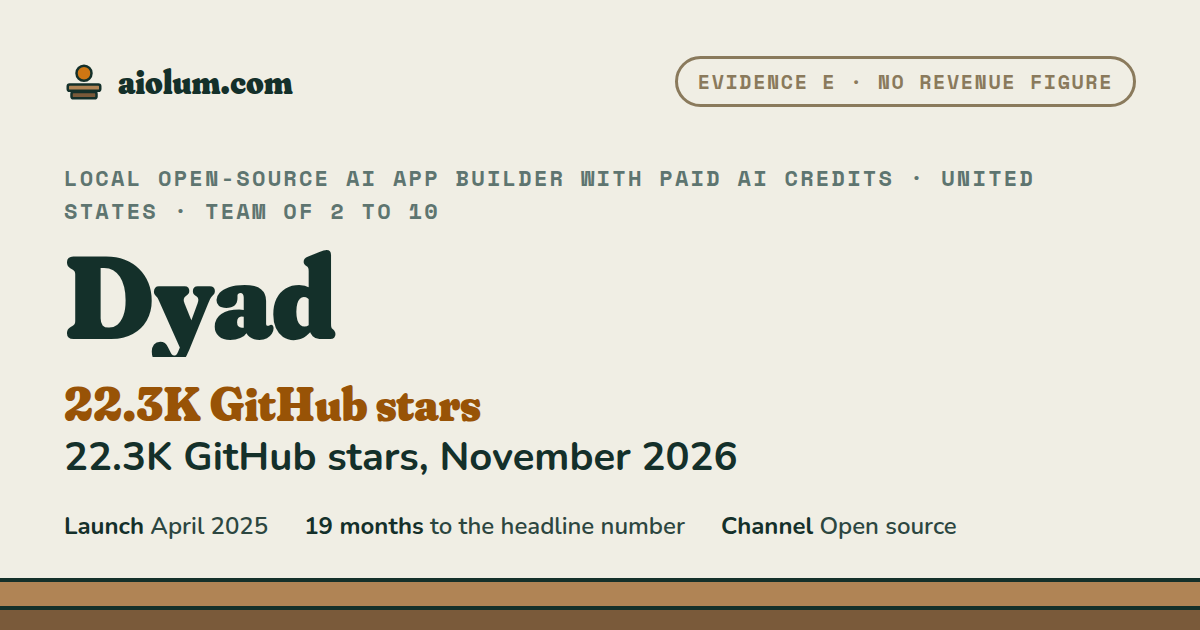
Dyad (Local open-source AI app builder with paid AI credits, United States): 22.3K GitHub stars, November 2026. Evidence grade E: no revenue figure was checked. Team: headcount not published; one creator named on the company site, which says "the Dyad team". Launched April 2025; still running.Added
- Outcome
- 22.3K GitHub stars, November 2026
- Evidence
- E no revenue figure was checked
- Launch
- April 2025
- Status
- Still running
- Team
- headcount not published; one creator named on the company site, which says "the Dyad team"
- Outside funding
- Bootstrapped, the creator's blog says; no outside funding found
- Main channel
- Open source
What is not verified
No revenue figure was found. What was looked for: a payment-processor profile, a founder interview, a press piece, a filing. TrustMRR has no profile under the name dyad. The company says Pro members pay, and its refund page and release notes imply it. No independent source confirms that any customer pays. The payment processor is not named. This story is grade E: the business is real and its product, price and customers are described from public pages, but no revenue figure was checked. Aiolum shows it as an idea worth studying, not as proof that it makes money.
Dyad is an AI app builder: the user describes an app in words, and a language model writes the code. The Dyad app is a desktop program that is free and open source, so its code is public and can be copied. The user connects an API key, a password that lets a program call a model provider on the user's account. The company also sells Dyad Pro and Dyad Max, which include AI credits, a monthly allowance for model usage that the company sells.
The home page and the Pro page name Will Chen as "Creator of Dyad". The first release tag on GitHub, v0.1.0, is dated 15 April 2025. The release notes of version 0.5.0 say that the company quietly launched Dyad Pro the week before 14 May 2025. The pricing page lists Pro at US$20 a month with 200 credits and Max at US$79 a month with 900 credits.
No revenue figure was found, so this story is grade E. The headline is a status fact: GitHub shows 22.3K stars, read on 12 November 2026. That customers pay rests on the company's own pages and notes. No press piece, filing or payment-processor profile was read.
Why did Dyad work?
Four causes, in the order they mattered. Each one is a reusable lesson.
It runs on the user's computer and leaves the code with the user
The company says each Dyad app is a regular Git repository on the user's computer, so users can switch to other tools. Users may bring their own API key, which the company says lets them choose any model, including local ones. The company says this is what separates Dyad from cloud builders such as Lovable, v0 and Bolt.
It sells AI credits and agent modes on top of the free app
The Pro page says the paid plans include a monthly credit allowance and Pro agent tools such as web search and image generation. The refund page says Dyad has already paid the AI providers when credits are used up. Credit usage is the company's own unit.
It ships Pro modes inside open releases within weeks of the first tag
The first tag is dated 15 April 2025 and the Pro launch is dated the week before 14 May 2025. Version 0.6.0 followed on 20 May 2025 with two Pro modes. The repository README says the code in src/pro uses a fair-source licence.
How it was built
These details come from the company's blog, FAQ and repository. They are grade C. [15, 12, 5, 17, 10]
- Dyad is a desktop program built with Electron. The blog says the agent loop that reads files, writes code and calls tools runs inside the Electron main process.
- It sends requests to cloud or local models through the Vercel AI SDK, the company's blog says.
- The FAQ says each release is built directly on GitHub and signed with a code-signing certificate of Dyad Tech., Inc.
- The privacy policy says the company uses PostHog for desktop telemetry, Umami Cloud for website analytics, Mailgun for transactional email and ConvertKit for subscriber lists.
- The blog says the repository uses Claude Code hooks, and that a hook calls Claude Sonnet to classify permission requests.
Tools named in the sources
Each one opens its page in the Tools tab, with every story that uses it.
Who tried this before Dyad, and why did they fail?
Three companies in a database of failed startups promised to let people build software faster, with a platform or an AI helper. The values below are from that database, read on 12 November 2026, and are not independently verified.
Builder.ai
The promiseCustom apps for non-technical founders, built by an AI-powered assembly line with human help.
Why it diedThe record says each project needed human labor, so costs grew with every customer and the AI was mostly a marketing layer.
Kite DevTool
The promiseAI code completion inside the programmer's editor.
Why it diedThe record says GitHub Copilot, launched in June 2021, gave much better suggestions and had GitHub's distribution.
Parse
The promiseA ready-made backend so a mobile developer could ship an app in hours.
Why it diedThe record says Facebook bought it in 2013 and shut it down in 2017, while Google's Firebase offered a free tier.
The failed startups come from our database of 1,749 dead startups, retold here in our own words. Its entries are AI-assisted summaries of public sources, so these cards carry no evidence grade.
What changed
Each of the three sold a faster way to build software, and each lost to a bigger company or to its own costs. Dyad faces the same two pressures. The records name large vendors that give away similar tools, and costs that grow with each customer.
Two things differ in what the sources show. The free app runs on the user's computer, so free users bring their own model key. The paid plans sell credits, and the refund page says Dyad pays the model providers for that usage. No source shows whether the credits make a profit.
Can one person copy Dyad now?
The structure, yes. The proof, not yet.
The pattern is a free open-source app that runs locally, with a paid plan for model credits and extra modes. No source shows how much Dyad earns or how many people work on it.
Where it is still open: Other jobs where users want the code on their own machine: data tools, document tools and internal apps for small companies.
- 1Publish a free desktop app under an open licence and let users bring their own model key.
- 2Post each release with notes, so users see the product change.
- 3Add a paid plan for what the free app cannot offer, such as bundled model usage.
- 4Publish prices and a refund policy on the page.
How much revenue does Dyad make?
Each row shows the evidence grade and the source numbers from the list at the end of this page. The grades are explained in How Aiolum verifies.
| Fact | Value | Grade | How we know | Sources |
|---|---|---|---|---|
| Prices, November 2026 | Pro US$20 a month with 200 credits; Max US$79 a month with 900 credits | C | Company pricing page: "Dyad Pro $20 /month" and "Dyad Max $79 /month". Credits can be reloaded at the same price. | [1, 2, 3] |
| Free version | free and open source, no sign-up | C | Company pages: "Free & open-source desktop app" and "No sign-up required". Users bring their own API key. | [2, 3] |
| First release tag on GitHub | v0.1.0, 15 April 2025 | C | The GitHub release page of the company's repository shows the tag date. No earlier release was found. | [9] |
| Earliest archived home page | 21 April 2025, 146 GitHub stars, "100+ builders" on Reddit | C | Internet Archive copy. It offered a free download and no price. Only this one early copy was found. | [11] |
| Dyad Pro launch | the week before 14 May 2025 | C | Release notes of version 0.5.0: "We quietly launched Dyad Pro last week and are already seeing promising early adoption." GitHub dates the release 14 May 2025. | [7, 8] |
| Paying customers | the company says Pro members exist and pay | C | The refund page says full refunds are not offered once all AI credits are used. No independent source confirms that customers pay. | [6, 7] |
| GitHub popularity, 12 November 2026 | 22.3K stars, 2.8K forks, 2,237 commits | C | The repository page of the company. Stars show interest and not paying users. | [10] |
| Legal entity | Dyad Tech., Inc., a US company | C | FAQ: code-signing certificate "from Dyad Tech., Inc". Terms: "As a US company". The terms were last updated 8 May 2025. | [12, 4, 2] |
| Creator | Will Chen | C | The home page and the Pro page print "Will Chen" under the title "Creator of Dyad" beside a quotation. The creator's blog says he left Google in 2025 after almost 9 years. | [1, 2, 19] |
| Team size | not published | C | The footer says "Built with care by the Dyad team". No page counts the people. | [2, 13] |
| Licence of the code | Apache 2.0, and Functional Source License 1.1 for src/pro | C | The repository README. The README names the src/pro folder as fair-source code. | [10] |
| Time from the first release tag to November 2026 | 19 months | calc | Calculated: April 2025 to November 2026, in whole months. | [9] |
How to read this table: a grade C value is what the company says on its own pages, or what its public repository shows. A grade X value was computed on this page. No value comes from a payment processor, a filing or a journalist.
| Plan | Per month, billed yearly (US$) | Per month, billed monthly (US$) | Limit |
|---|---|---|---|
| Dyad Free | 0 | open-source desktop app; bring your own API key; basic agent limited to 20 messages a day | |
| Dyad Pro | 20 | 200 AI credits a month; Pro agent modes; Dyad Academy | |
| Dyad Max | 79 | 900 AI credits a month; prioritized access to office hours |
The pages show one monthly price for each plan and no yearly price. Dyad Pro also lists a token orchestration fee of 1.5 credits per million tokens for some uses. The FAQ says unused credits roll over while the subscription lasts, up to 3,600 credits.
When did Dyad launch, and how did it grow?
From a first release tag in April 2025 to a price list with two paid plans in November 2026. Each entry carries its grade.
- 15 April 2025CThe first release tag, v0.1.0, appears on GitHub. [9]
- 21 April 2025CThe earliest archived home page offers a free download, shows 146 GitHub stars and invites readers to join 100+ builders on Reddit. [11]
- 8 May 2025CThe terms of service carry this date as their last update. [4]
- 14 May 2025CRelease 0.5.0 says Dyad Pro was quietly launched the week before and has early adoption. [7, 8]
- 20 May 2025CRelease 0.6.0 adds two Pro modes, Smart Context and Turbo Edits, and tells readers to become Pro members. [16, 20]
- 12 November 2026CThe pricing page lists Pro at US$20 and Max at US$79 a month, and GitHub shows 22.3K stars. [1, 10]
What could go wrong for Dyad?
The risks are the mirror image of the causes above.
What is not verified
No revenue figure was found. What was looked for: a payment-processor profile, a founder interview, a press piece, a filing. TrustMRR has no profile under the name dyad. The company says Pro members pay, and its refund page and release notes imply it. No independent source confirms that any customer pays. The payment processor is not named.
Counters and testimonials
The home page shows counters that no source backs: "3,000+ builders" on Reddit, "+ 20 Contributors" and "20k GitHub stars". GitHub itself shows 22.3K stars. Most testimonials carry Reddit, X and Product Hunt handles. Two carry a full name, with a company or a profession. No search for reuse of the quotations elsewhere could be made.
Features and pages that need a neutral note
The Pro table lists "Website cloning" as a Pro agent tool. A company blog post gives "cloning a website layout" as an example task. No page says what else it copies, or whose sites may be copied. The plans also work with a user's ChatGPT subscription. The company says Dyad charges up to 1.5 credits per million tokens for this in Agent mode. OpenAI's terms for such use were not read. One company blog post about a "side hustle" says builders sell tools for "$200 to $2,000 per project". The same post says "most micro-SaaS apps fail to find paying users".
Start date and team
The start is dated by the creator's blog and the first release tag, not by a register. The blog, on a subdomain of the company site, says he left Google in 2025 to build the business. It says he threw away an earlier version, Dyad v0, an AI coach for junior programmers. The first release tag is 15 April 2025. The entity Dyad Tech., Inc. has no start year in any downloaded page. No earlier name was found, and older domains were not searched. No page says how many people work at the company. The blog describes 2025 as working "by yourself", and its January 2026 post says "we".
Sources
The grade next to each source is the best grade that the source can support. "Read in full" means that the text of the page was downloaded and the numbers were checked in it.
- C Dyad Pro page, read 12 November 2026Read in full. Source for the plans, the credits, the Pro agent tools, the audience line and the creator's name.
- C Dyad home page, read 12 November 2026Read in full. Source for the product, the plans, the counters, the testimonials and the footer with the company name.
- C Dyad plans page, read 12 November 2026Read in full. Repeats the three plans and their prices.
- C Dyad Terms of Service, last updated 8 May 2025Read the opening and the payment sections. Source for the date and the statement that Dyad is a US company.
- C Dyad Privacy PolicyRead in full. Source for the analytics, telemetry and email tools, and for the lack of any age or children section.
- C Dyad Refund policy, last updated 18 August 2025Read in full. Source for the statement on AI credits and refunds.
- C Dyad release notes 0.5.0Read in full. Source for the sentence on the quiet launch of Dyad Pro.
- C GitHub release v0.5.0 of dyad-sh/dyadRead the date line. Source for the release date of 14 May 2025.
- C GitHub release v0.1.0 of dyad-sh/dyadRead the date line. Source for the first release tag of 15 April 2025.
- C GitHub repository dyad-sh/dyad, read 12 November 2026Read in full. Source for the stars, forks, commits, the licence text and the repository description.
- C Internet Archive copy of the Dyad home page, 21 April 2025Read in full. It is the earliest copy the Wayback availability lookup returned. It shows no price.
- C Dyad FAQRead in full. Source for the local code, the entity name in the code-signing sentence and the build on GitHub.
- C Dyad blog index, read 12 November 2026Read in full. Checked who the blog addresses: app builders, hobbyists and non-coders. It names no children.
- C Dyad blog: Vibe coding side hustleRead in full. Source for the note on client prices in the watch section.
- C Dyad blog: AI Agent Tool Calling in ElectronRead the opening and the architecture sections. Source for Electron and the Vercel AI SDK.
- C Dyad release notes 0.6.0Read in full. Source for the two Pro modes added in this release. GitHub dates the release 20 May 2025.
- C Dyad blog: AI-Powered Claude Code Permission HooksRead the opening and the hook sections. Source for Claude Code and Claude Sonnet in the repository's own workflow.
- C Database of failed startups, local exportRecord pages read on the website on 12 November 2026. AI-written summaries, not independently verified. Source for the failed predecessors.
- C Indie Will, the Dyad creator's blog: What I did in 2025, 2 January 2026Read in full. Source for the creator leaving Google in 2025 and for the discarded Dyad v0. The blog's subtitle is "Ramblings of a bootstrapped founder".
- C GitHub release v0.6.0 of dyad-sh/dyadRead the date line. Source for the release date of 20 May 2025.
Run this company? Send corrections or a verified figure to aiolum@livyden.com