Remodex: Revenue, team and how it was built
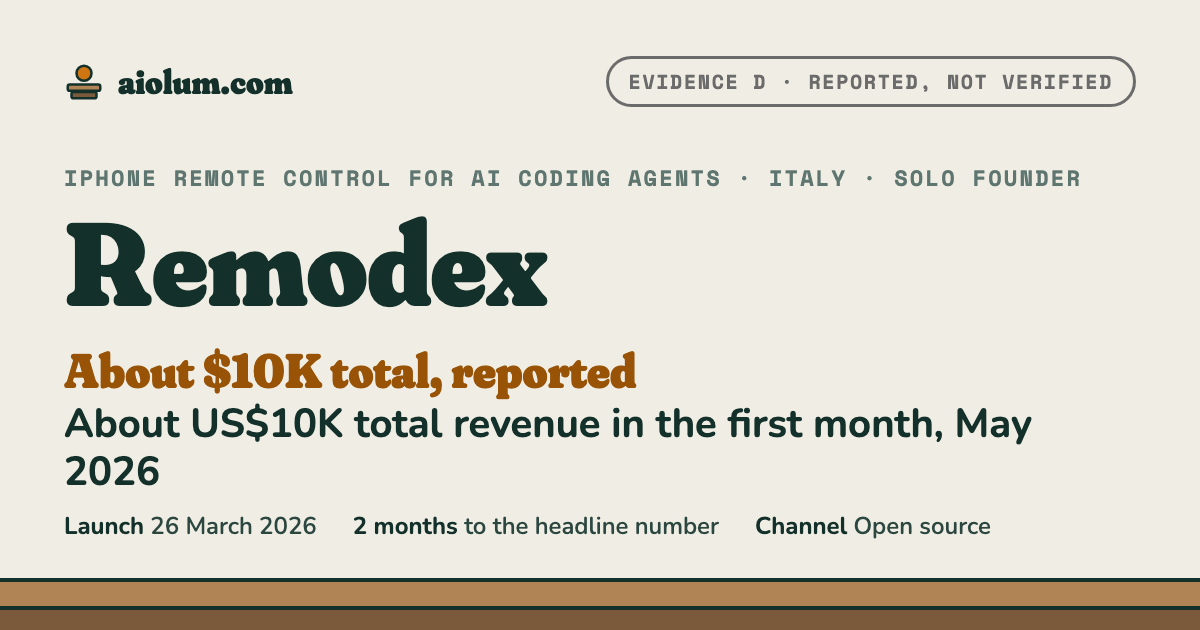
Remodex (iPhone remote control for AI coding agents, Italy): About US$10K total revenue in the first month, May 2026. Evidence grade D: reported, not verified. Team: 1 founder, a computer science student, who builds and supports the app alone. Launched 26 March 2026; still running.Added 3 November 2026
- Outcome
- About US$10K total revenue in the first month, May 2026
- Evidence
- D reported, not verified
- Launch
- 26 March 2026
- Status
- Still running
- Team
- 1 founder, a computer science student, who builds and supports the app alone
- Outside funding
- None reported
- Main channel
- Open source
What is not verified
The headline figure, about US$10,000 in total revenue about a month after launch, rests on one source: an MRR Story case study published on 16 May 2026, which says it is compiled from public sources and presented in an interview format, so it is not a verified interview. The same page shows "$10K /mo" in a side card, which disagrees with its own text, and gives a lifetime price of US$498.00 that the App Store does not list. No payment processor, App Store report or second dated figure confirms the revenue. A reader could look for the founder's own dashboard screenshot on his X account @emanueledpt, a TrustMRR profile, or a later interview with a dated figure. The headline number is grade D: one claim or one estimate, with no second source. Aiolum shows it because the story is useful, and marks it so that it is not mistaken for a verified figure.
Remodex is a remote control for an AI coding agent, a program in which a large language model reads a code project, runs commands and edits files to finish a task that the developer describes in words. The agent here is OpenAI's Codex, which runs on the developer's Mac. A small bridge, a Node.js program installed with npm i -g remodex@latest, connects Codex to the Remodex iPhone app through a relay, a server that passes messages between two devices that cannot reach each other directly. The messages are end-to-end encrypted: only the phone and the Mac hold the keys, so the relay cannot read prompts or code.
Emanuele Di Pietro, a computer science student in Naples, built the first version in one night on 8 March 2026, using Codex to write the code. Version 1.0 appeared on the App Store on 26 March 2026, and the Product Hunt launch on 1 April 2026 finished sixth of the day. On 25 April 2026 Federico Viticci of MacStories called it the best Codex remote client for iOS. An MRR Story case study of May 2026 reported that the app reached about US$10,000 in total revenue about a month after launch.
This page gives the story the grade D, reported, not verified. The revenue figure appears in one source, and that source says it is compiled from public sources and written in interview form, not an interview. The app, its developer and its prices are checked on the App Store, the product site, GitHub and MacStories.
How much revenue does Remodex make?
Each row shows the evidence grade and the source numbers from the list at the end of this page. The grades are explained in How Aiolum verifies.
| Fact | Value | Grade | How we know | Sources |
|---|---|---|---|---|
| Total revenue about a month after launch | about US$10,000 | D | MRR Story case study published 16 May 2026, in the founder's voice: "we hit roughly $10,000 in total revenue about a month post-launch". The page says it "is compiled from public sources and presented in an interview format", so the words are not a verified quotation. The same page's side card shows "$10K /mo", which disagrees with its own text; this page uses the text, total revenue. | [1] |
| Annual price as a monthly amount | about US$2.50 a month | calc | Calculated: US$29.99 divided by 12. | [2] |
| Prices | free; US$3.99 a month, US$29.99 a year, Remodex Pro US$69.99 | C | US App Store page, read 3 November 2026. MacStories gave the same two subscription prices on 25 April 2026. | [2, 4] |
| Developer and seller | Emanuele Di Pietro | C | App Store page: developer, seller and copyright "© Emanuele Di Pietro - 2026". The product site links to this App Store page and to the GitHub account Emanuele-web04, and Product Hunt lists him as the maker. MacStories names him as the Italian indie developer who created the app. | [2, 3, 5, 4] |
| Founder's age and studies | 22, computer science student at the University Federico II, Naples | D | MRR Story only. He was an adult when the figure was reported. | [1] |
| Team | 1 person | C | MRR Story lists 1 founder and 0 employees. The GitHub README says "I am not actively accepting contributions yet". | [1, 3] |
| First version | built in one night, 8 March 2026, with Codex writing the code | D | MRR Story: the first working version was done by 4:00 in the morning. | [1] |
| App Store release | version 1.0 on 26 March 2026 | C | App Store version history. | [2] |
| Product Hunt launch | 1 April 2026, sixth of the day, 181 points | C | Product Hunt product page; the maker's first comments are dated 31 March and 1 April 2026. | [5] |
| App Store ratings, November 2026 | 35 ratings, 3.7 out of 5 | C | US App Store page, read 3 November 2026. Category Developer Tools, age rating 4+. | [2] |
| GitHub repository, November 2026 | 3.3k stars, 378 forks, 579 commits, Apache 2.0 license | C | github.com/Emanuele-web04/remodex, read 3 November 2026. | [3] |
| Technical base | OpenAI's official open-source Codex App Server | C | MacStories, 25 April 2026: "it's entirely powered by OpenAI's official (and open-source) Codex App Server". So it does not depend on an unofficial workaround. | [4] |
| Encryption | X25519 key exchange, Ed25519 signatures, AES-256-GCM, replay protection | C | Product site FAQ and the maker's Product Hunt post. | [6, 5] |
| Outside funding | none reported | C | No source mentions investors or a funding round. | [1, 4] |
| Time from launch to the reported figure | 2 months | calc | Calculated: March 2026 to May 2026, the month of the MRR Story report. The report itself says about one month after launch. | [2, 1] |
How to read this table: a grade D value appears in one source only, here an MRR Story case study compiled from public sources, and no payment processor or second dated report confirms it. A grade C value is read on the App Store page, the product site, GitHub, Product Hunt or in the MacStories review. A "calc" value was computed on this page from the rows above it. No value is grade A or B.
| Plan | Per month, billed yearly (US$) | Per month, billed monthly (US$) | Limit |
|---|---|---|---|
| Free | 0 | 0 | basic remote access; five free messages since version 1.5 |
| Pro, subscription | 2.50 | 3.99 | US$29.99 billed yearly |
| Remodex Pro, one-time | 69.99 one-time | named Remodex Pro in the App Store list |
The app is a free download. The App Store lists three in-app purchases: Monthly US$3.99, Annual US$29.99 and a one-time item named Remodex Pro at US$69.99. Version 1.5 of 5 May 2026 added lifetime access and five free messages before an upgrade is needed. MRR Story's May 2026 case study gave a lifetime price of US$498.00, which does not match the App Store listing in November 2026. Users who run their own relay can use the open-source code, under the Apache 2.0 license, without the hosted service. The Codex subscription or API use is paid to OpenAI separately.
When did Remodex launch, and how did it grow?
From a one-night challenge in March 2026 to version 4.0 with a second coding agent in October 2026. Each entry carries its grade.
- Before 2026DThe founder publishes more than nine iOS apps with about 3,200 downloads in total and studies at the Apple Developer Academy, according to MRR Story. [1]
- Early 2026DHe starts Phodex, a cloud setup for coding without a Mac, then drops it when reports say OpenAI is building its own remote feature. [1]
- 8 March 2026DHe sets himself the goal of shipping a Codex iPhone app before OpenAI and builds the first working version overnight. [1]
- 26 March 2026CVersion 1.0 appears on the App Store under his own name. [2]
- 1 April 2026CProduct Hunt launch: sixth of the day with 181 points. [5]
- 25 April 2026CMacStories calls Remodex the best Codex remote client for iOS, until OpenAI releases its own. [4]
- 5 May 2026CVersion 1.5 adds Plan Mode, lifetime access and five free messages before an upgrade. [2]
- 16 May 2026DMRR Story reports about US$10,000 in total revenue about a month after launch. [1]
- By 22 June 2026COpenAI has released its own mobile Codex app, according to an App Store review of that date that explains why the reviewer still uses Remodex. [2]
- 4 August 2026CVersion 3.0 adds live sync with Codex Desktop, long-running goals and Live Activities. [2]
- 1 October 2026CVersion 4.0 adds OpenCode, a second coding agent, next to Codex. [2]
Why did Remodex work?
Four causes, in the order they mattered. Each one is a reusable lesson.
Ship before the platform owner
OpenAI had no iPhone app for Codex in March 2026, and reports said one was coming. The founder built the first version in one night and was in the App Store 18 days later. MacStories wrote that it hoped OpenAI would copy the app; MRR Story reported that the first month brought about US$10,000 before that happened.
Open code for trust, hosted service for money
Developers do not want a stranger's server to see their code. The Mac bridge and the relay are open source, the messages are end-to-end encrypted, and anyone can run their own relay. The paid App Store version sells the convenience of a hosted relay with no setup.
Built on an official interface
Remodex uses OpenAI's Codex App Server, which OpenAI publishes for third-party tools. MacStories noted that OpenAI, unlike Anthropic, does not block such tools. That made an unofficial client possible without breaking a provider's terms.
One review that reached the right readers
A MacStories article by its editor-in-chief reached Apple users who code. MRR Story says this review sent early adopters to the App Store page.
How it was built
These details come from the GitHub README, the product site, the App Store notes, the maker's Product Hunt post and MacStories (grade C), and from MRR Story (grade D). [3, 6, 2, 5, 4, 1]
- Three layers: a native iOS app, a Node.js bridge on the Mac that forwards JSON-RPC messages and runs git, and Codex itself, started as codex app-server.
- Pairing by a one-time QR code that carries the connection details and the bridge's public key; the iPhone then stores the Mac in the Keychain and reconnects without a new scan.
- On macOS the bridge runs as a background service through launchd, so the phone can reconnect while the terminal is closed.
- The relay can be self-hosted; the README recommends Tailscale for a private network.
- The first version was written with Codex in one night, according to MRR Story. The founder told MRR Story that he built his own revenue dashboard because RevenueCat felt too limited.
- Customers came from Product Hunt, his posts on X, the GitHub repository and the MacStories review; no source mentions paid advertising.
Tools named in the sources
Each one opens its page in the Tools tab, with every story that uses it.
Who tried this before Remodex, and why did they fail?
Four companies in our database of failed startups built a useful layer on top of a platform or a workflow owned by someone else, and lost when bigger products offered the same thing. The values below are from that database and are not independently verified.
Xmarks
The promiseSync bookmarks and tabs across several browsers.
Why it diedThe browsers built sync in for free, so the extra layer had nothing left to sell.
Readability
The promiseClean, ad-free reading of any web article.
Why it diedBrowsers added a free reader mode, and too few readers paid.
Screenhero
The promiseRemote screen sharing in which several people control one computer.
Why it diedIt was sold to Slack, lost its own product, and Zoom and Teams built the feature into larger tools.
Snapboard
The promiseOne dashboard for all of a developer's tools.
Why it diedMany similar apps with larger budgets and AI features appeared, and it had no income beyond subscriptions.
The failed startups come from our database of 1,749 dead startups, retold here in our own words. Its entries are AI-assisted summaries of public sources, so these cards carry no evidence grade.
What changed
Each of the four sold a layer on top of something that a larger company owned or could copy, and each lost when that company built the same feature in for free. Remodex has the same risk, and it arrived quickly: an App Store review of June 2026 says that OpenAI had released its own mobile Codex app. The founder told MacStories that he took on the challenge knowing that OpenAI would release its own version.
Two things differ. The cost was close to zero: one person, one night for the first version, no funding, and an official interface from OpenAI instead of a fragile workaround. And the product kept a reason to exist after the official app: the June 2026 review says Remodex works without the phone and the Mac being logged in to the same account, and version 4.0 added a second agent, OpenCode, which an OpenAI app is unlikely to support.
Can one person copy Remodex now?
The timing, no. The pattern, yes.
The opening for a Codex iPhone client lasted a few months, until OpenAI shipped its own. The pattern repeats each time a new AI tool runs only on one device or one interface: build the missing client quickly on the official interface, publish the code so that developers trust it, and charge a small subscription for the hosted part. MRR Story reported that this gave about US$10,000 in the first month; no second source confirms it.
Where it is still open: Clients for other coding agents and AI tools on devices their makers ignore: watches, tablets, cars, Android, and one app that controls several agents at once.
- 1Watch for AI tools that publish an official server or protocol for third-party clients but have no client on some device.
- 2Build the first version within days, on the official interface, not on a reverse-engineered one.
- 3Publish the part that touches the user's code as open source, with end-to-end encryption, and sell the hosted convenience.
- 4Plan for the platform owner to copy you: add the features and agents that the owner will not support.
What could go wrong for Remodex?
The risks are the mirror image of the causes above.
What is not verified
The headline figure, about US$10,000 in total revenue about a month after launch, rests on one source: an MRR Story case study published on 16 May 2026, which says it is compiled from public sources and presented in an interview format, so it is not a verified interview. The same page shows "$10K /mo" in a side card, which disagrees with its own text, and gives a lifetime price of US$498.00 that the App Store does not list. No payment processor, App Store report or second dated figure confirms the revenue. A reader could look for the founder's own dashboard screenshot on his X account @emanueledpt, a TrustMRR profile, or a later interview with a dated figure.
OpenAI released its own app
MacStories wrote on 25 April 2026 that it hoped OpenAI would copy Remodex. An App Store review dated 22 June 2026 says OpenAI had released a mobile Codex app by then. No source shows Remodex's revenue after that date.
Dependent on Codex and its interface
The app works only while OpenAI keeps the Codex App Server open to third-party tools and the user keeps a Codex subscription or API account. Adding OpenCode in October 2026 reduced this dependence on one provider.
Reliability complaints
The App Store rating is 3.7 out of 5 from 35 ratings in November 2026. Reviews report session sync problems and jumpy scrolling, MacStories mentioned responses loaded out of order, and MRR Story says early users had unstable connections when switching from Wi-Fi to mobile data.
Sources
The grade next to each source is the best grade that the source can support. "Read in full" means that the text of the page was downloaded and the numbers were checked in it.
- D MRR Story, case study, 16 May 2026: From Midnight Idea to $10K Revenue in 30 DaysRead in full, downloaded 3 November 2026. A retelling compiled from public sources in interview form, not an interview. The only source for the revenue figure, the founder's age and studies, the one-night build and the earlier apps.
- C App Store (US): Remodex - Remote AI Coding, read 3 November 2026Read in full. Developer and seller name, in-app purchase prices, ratings, reviews with their dates, and the version history from 1.0 on 26 March 2026 to 4.0 on 1 October 2026.
- C GitHub: Emanuele-web04/remodex, read 3 November 2026Read the repository page and README. Stars, forks, commits, license, architecture, self-hosting and the note on contributions.
- C MacStories, Federico Viticci, 25 April 2026: Remodex Is the Best Codex Remote Client for iOS (Until OpenAI Releases an Official Codex Mobile App)Read in full. An independent review with the founder's own quotations. Source for the Codex App Server base, the subscription prices and the risk of an official OpenAI app.
- C Product Hunt: Remodex, Codex remote controlRead the product page and the maker's launch post. Source for the launch date, the day rank and the three-layer design.
- C Remodex product site, home page, read 3 November 2026Read in full. Links to the App Store page and to the GitHub repository; FAQ on setup, encryption and self-hosting.
- C Database of failed startups, local exportLocal export. AI-written summaries, not independently verified. Source for the failed predecessors.