TraceRoot.AI: Product, team and how it was built
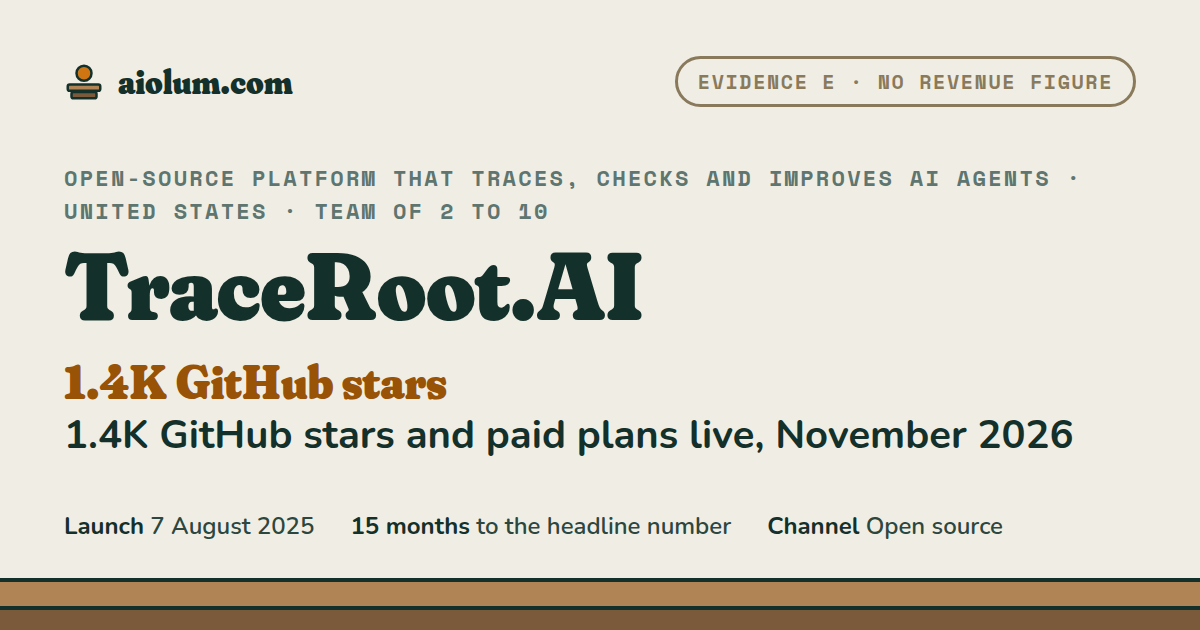
TraceRoot.AI (Open-source platform that traces, checks and improves AI agents, United States): 1.4K GitHub stars and paid plans live, November 2026. Evidence grade E: no revenue figure was checked. Team: 1 founder listed; team size 4 on Y Combinator's company page, November 2026. Launched 7 August 2025; still running.Added
- Outcome
- 1.4K GitHub stars and paid plans live, November 2026
- Evidence
- E no revenue figure was checked
- Launch
- 7 August 2025
- Status
- Still running
- Team
- 1 founder listed; team size 4 on Y Combinator's company page, November 2026
- Outside funding
- Y Combinator Summer 2025 batch; no amount stated in the sources read
- Main channel
- Open source
What is not verified
No revenue figure was found, so the story is grade E. The home page, pricing, terms, privacy notice, blog, changelog, repository and download counters were read. A reader could look for a payment-processor profile or a press interview. The company said on 7 August 2025 that the SDK had 10,000 downloads. Pepy's counter shows 80,752 today, and that total includes automated traffic. PyPI Stats counted 1,055 downloads in the last month, against 3,134 on Pepy. No source states that a customer has paid. Y Combinator says the company was founded in 2025, and no earlier name was found. This story is grade E: the business is real and its product, price and customers are described from public pages, but no revenue figure was checked. Aiolum shows it as an idea worth studying, not as proof that it makes money.
TraceRoot.AI is an open-source platform for agent observability. That means recording each model call and tool call of an AI agent, so that engineers can see why a run went wrong. A full recording of one run is a trace, and detectors are checks that an AI model runs over traces to flag failures. Evals are tests that compare an agent before and after a change.
Y Combinator's company page lists Xinwei He as founder and chief executive. It says the company was founded in 2025, in the Summer 2025 batch, with a team size of 4. The GitHub organization dates from 22 June 2025, the launch post from 7 August 2025 and the first code release from 8 August 2025. The company's home page lists a free plan and paid plans of US$30 and US$200 a month.
No revenue figure was found, so the story is grade E. The headline is the repository's 1,392 stars in GitHub's record, read on 12 November 2026, and the paid plans on sale. Pepy's counter shows 80,752 downloads of the Python SDK, a total that includes automated traffic. A paid plan can be bought through Stripe checkout, and no source states that a customer has paid.
Why did TraceRoot.AI work?
Four causes, in the order they mattered. Each one is a reusable lesson.
The free code and a free plan come before any payment
The core code is licensed under Apache 2.0, and the home page offers a free plan with no credit card. Paid plans start at US$30 a month. The repository shows 1,392 stars. Pepy's counter shows 80,752 downloads of the Python SDK, a total that includes automated traffic. No source says how many users pay.
The pitch moved from fixing bugs to improving agents
The launch post of August 2025 described AI agents that fix production bugs and draft pull requests. The home page of November 2026 describes tracing, detectors, signals and evals around a coding agent. The company's llms.txt file says older descriptions about fix pull requests may not reflect the current workflow.
Plans are priced by events and runs, with overage billed
Starter includes 150,000 events a month and charges US$4 for each 50,000 more. Chat and root-cause runs have their own limits and extra charges. A small team pays a flat US$30 a month, and a heavy user pays by volume.
How it was built
These details come from the company's own pages and from GitHub. They are grade C. [6, 7, 5, 8]
- The SDKs for Python and TypeScript send traces over OpenTelemetry, an open standard for telemetry data. The service description also lists a command-line tool and plugins for coding agents.
- The hosted platform runs on Amazon Web Services in the us-east-1 region, according to the security page. The privacy notice lists Daytona sandboxes for the analysis agent.
- The analysis agent and the detector runs send traces to Anthropic or OpenAI models. The privacy notice says the keys are the customer's or the company's.
- Billing goes through Stripe, product analytics through PostHog and transactional email through Resend, according to the same notice.
- The platform can be self-hosted with Docker. The company lists a Helm chart and a Terraform module for Amazon Web Services.
Tools named in the sources
Each one opens its page in the Tools tab, with every story that uses it.
Who tried this before TraceRoot.AI, and why did they fail?
Three companies in our database of failed startups sold developer tools that found bugs, explained code, or turned open-source adoption into a business. The values below are from that database, were read on 12 November 2026 and are not independently verified.
CodeSee
The promiseInteractive maps of a codebase, so that developers understand complex code faster.
Why it diedThe record says it failed to prove a return to engineering leaders, and a nice-to-have tool could not justify a budget.
WunderGraph
The promiseAn open-source framework that joins GraphQL, REST and databases into type-safe APIs.
Why it diedThe record says it failed to earn from open-source adoption, and enterprise sales were too slow.
Sider
The promiseAutomated code review and static analysis that catch bugs and security flaws in build pipelines.
Why it diedThe record says it was squeezed between free open-source tools and enterprise platforms that bundled code analysis.
The failed startups come from our database of 1,749 dead startups, retold here in our own words. Its entries are AI-assisted summaries of public sources, so these cards carry no evidence grade.
What changed
The three records share one trouble: developers used the tool, and budget holders did not pay for it. CodeSee could not show a return, WunderGraph earned little from open-source use, and Sider met free tools and large suites. TraceRoot faces the same question, because its core code is free.
Two things differ from the records. The product watches AI agents, which are new software that many teams have just begun to run in production. The platform also sells a fixed monthly price with a free start. Whether enough teams pay is not shown by any source found.
Can one person copy TraceRoot.AI now?
The open-source-then-hosted structure can be copied; the result is not shown.
A small team can publish the code of a tool for a new kind of software and sell a hosted plan. The sources show downloads, stars and a price list, and they show no revenue. Treat this as a pattern, not as proof that it earns.
Where it is still open: Other gaps around agents in production: cost control, permissions, safety checks and replay of failed runs, each as open code with a hosted plan.
- 1Pick a gap that teams hit when a new kind of software reaches production, such as agents that fail without an error.
- 2Publish the code under a permissive licence, with SDKs that install in one command.
- 3Offer a free hosted plan, then a low flat plan with usage limits.
- 4Add a command-line tool for the coding agents that engineers already use.
How much revenue does TraceRoot.AI make?
Each row shows the evidence grade and the source numbers from the list at the end of this page. The grades are explained in How Aiolum verifies.
| Fact | Value | Grade | How we know | Sources |
|---|---|---|---|---|
| Company and founder | TraceRoot, Inc.; Xinwei He, Founder/CEO | C | The terms of service name TraceRoot, Inc. Y Combinator's company page lists Xinwei He as the one active founder and gives San Francisco as the place. | [4, 2] |
| Start of the company | 2025; Y Combinator Summer 2025 batch | C | Y Combinator's company page says Founded: 2025. No earlier name, product or domain was found: the closest Internet Archive copy of traceroot.ai to 1 January 2024 is dated 18 July 2025. | [2, 16] |
| Team | 4 people on Y Combinator's page; one founder listed | C | The company page says Team Size: 4 and lists open jobs for a founding engineer, a go-to-market lead and two interns. No other founder is named in the sources read. | [2] |
| First public traces | GitHub organization on 22 June 2025; platform repository on 22 July 2025 | C | GitHub's own records. The SDK repository for Python was created on the same day as the organization. | [10] |
| Launch post | 7 August 2025 | C | Y Combinator's launch page for the company, created on that date. The post describes AI agents that fix production bugs. | [3] |
| First release of the platform code | v0.1.0 on 8 August 2025 | C | GitHub's release page, published by the GitHub account XinweiHe, with a list of changes by four contributors. | [9] |
| SDK downloads, company statement | 10,000 downloads | C | The launch post of 7 August 2025 says: Our SDK just crossed 10,000 downloads. This is the company's own statement, with that date. | [3] |
| SDK downloads, public counter | 80,752 in total; 3,134 in the last 30 days | C | Pepy.tech, read on 12 November 2026. Its page says: "Includes CI traffic." A download is not a user. PyPI Stats showed 1,055 downloads in the last month on the same day, about a third of Pepy's 3,134. | [11, 12] |
| GitHub repository | 1,392 stars, 324 forks | C | GitHub's record, read on 12 November 2026. The home page says there are 80 contributors. The licence is Apache 2.0 outside directories named ee. | [10, 1, 18] |
| Prices today | Free; Starter US$30 a month; Pro US$200 a month; Enterprise custom | C | The company's home page, read on 12 November 2026. | [1] |
| How a plan is bought | Self-serve sign-up; payment through Stripe checkout | C | The Free, Starter and Pro buttons read Get started and lead to the company's app. The privacy notice says billing details are entered on Stripe's pages. The service description says current prices are shown at checkout. | [1, 5, 6] |
| Funding | Y Combinator Summer 2025 batch; no amount stated | C | The home page says Backed by Y Combinator. No source read gives an amount or other investors. | [1, 2] |
How to read this table. Grade C means the company states the value, or a public record such as GitHub or a download counter shows it. No value is grade A or B, and no calc value is used.
| Plan | Per month, billed yearly (US$) | Per month, billed monthly (US$) | Limit |
|---|---|---|---|
| Free | 0 | 2 seats, 50,000 events a month, 15-day retention, 100 detector runs a month | |
| Starter | 30 | unlimited seats, 150,000 events a month, 30-day retention, 100 chat and 100 root-cause runs | |
| Pro | 200 | Starter plus 90-day retention, higher rate limits, SOC 2 report and HIPAA agreement | |
| Enterprise | custom | custom retention and support terms; the button reads Talk to founder |
The page lists every plan per month, with no yearly discount. All plans accept the customer's own model keys, or hosted models. Starter charges US$4 for each 50,000 events above 150,000 a month. The service description adds US$10 for each 100 extra chat runs or root-cause runs, and says current prices are shown at checkout.
When did TraceRoot.AI launch, and how did it grow?
From a GitHub organization in June 2025 to a hosted platform with a price list in November 2026.
- 22 June 2025CGitHub shows the organization traceroot-ai created, with the Python SDK repository on the same day. [10]
- 22 July 2025CGitHub shows the platform repository, traceroot, created. The TypeScript SDK repository follows on 24 July. [10]
- 7 August 2025CLaunch post on Y Combinator's site. It says the SDK crossed 10,000 downloads and that teams use the product to monitor and debug production systems. [3]
- 8 August 2025CFirst release of the platform code, v0.1.0, one day after the launch post. [9]
- 25 June 2026CThe changelog lists a command-line tool that reads traces from a terminal. Signals, which group failures into problems, follow on 7 October 2026. [15]
- 12 November 2026CThe repository shows 1,392 stars. Pepy's counter shows 80,752 downloads of the Python SDK, a total that includes automated traffic. [11, 10]
What could go wrong for TraceRoot.AI?
The risks are the mirror image of the causes above.
What is not verified
No revenue figure was found, so the story is grade E. The home page, pricing, terms, privacy notice, blog, changelog, repository and download counters were read. A reader could look for a payment-processor profile or a press interview. The company said on 7 August 2025 that the SDK had 10,000 downloads. Pepy's counter shows 80,752 today, and that total includes automated traffic. PyPI Stats counted 1,055 downloads in the last month, against 3,134 on Pepy. No source states that a customer has paid. Y Combinator says the company was founded in 2025, and no earlier name was found.
Home-page numbers are not sourced, and two pages differ on audits
The home page gives no source for its counters, and its audit sentence differs from the security page. The counters are 8.4M traces in 90 days, 31% better success rate, 42% lower latency, and US$100K saved a year per large workflow. The page also shows 80 contributors. The home page says: "SOC 2 Type II, HIPAA, ISO 27001 audited by Oneleet." The security page of September 2026 says: "We are working toward a SOC 2 Type II report with Oneleet as our compliance partner; the audit is in progress and the report will be available under NDA once issued." It adds: "We are HIPAA compliant, and ISO 27001 readiness follows." The Pro plan lists a SOC 2 report. The trust center page loads by script and was not read. No logo wall or testimonial was found.
Open core, with an engineering service
The code outside directories named ee is Apache 2.0. The company's llms.txt file says billing, the built-in AI agent and Signals are source-available under a separate Enterprise License. A forward deployed engineer page offers engineers who work inside a customer's team, billed on engineering hours and results.
The product description changed
The launch post of August 2025 spoke of agents that automatically fix production bugs. The home page of November 2026 speaks of improving agents through signals and evals. The company's llms.txt file says older descriptions may not reflect the current workflow.
Sources
The grade next to each source is the best grade that the source can support. "Read in full" means that the text of the page was downloaded and the numbers were checked in it.
- C traceroot home page, with plans and FAQRead in full on 12 November 2026. Source for the product description, the plans, the counters, the badges and the app links.
- C Y Combinator company page: TraceRoot.AIRead in full on 12 November 2026. Source for the founder, the batch, the year founded, the team size and the open jobs.
- C Y Combinator launch page: TraceRoot - Open source AI agents that automatically fix your production bugsRead in full on 12 November 2026. The company's own post, created on 7 August 2025. Source for the 10,000 downloads statement.
- C traceroot terms of serviceRead in full on 12 November 2026. Source for the company name TraceRoot, Inc. and the fees clause.
- C traceroot privacy policyRead in full on 12 November 2026. Source for Stripe checkout and the list of service providers.
- C traceroot service descriptionRead in full on 12 November 2026. Source for the plan limits, the overage prices, the checkout sentence and the integrations.
- C traceroot security pageRead in full on 12 November 2026. Source for the hosting region and the SOC 2 status of September 2026.
- C traceroot llms.txtRead in full on 12 November 2026. Source for the licence terms and the note on older descriptions.
- C GitHub releases of traceroot-ai/traceroot, page 6Read the release v0.1.0 and its dates on 12 November 2026. Source for the first release of 8 August 2025.
- C GitHub API: repository, organization and repositories of traceroot-aiRead the three records on 12 November 2026. Source for the creation dates, the stars and the forks.
- C Pepy.tech: traceroot on PyPIRead in full on 12 November 2026. Source for the total of 80,752 downloads, which includes automated-build traffic.
- C PyPI Stats: tracerootRead on 12 November 2026. Source for the downloads of the last day, week and month.
- C traceroot blog indexRead in full on 12 November 2026. Lists 13 posts from 14 June to 2 November 2026; none states revenue or customers.
- C traceroot forward deployed engineers pageRead in full on 12 November 2026. Source for the engineering service and its billing.
- C traceroot changelogRead in full on 12 November 2026. Source for the dates of the command-line tool and Signals.
- C Internet Archive availability record for traceroot.aiRead on 12 November 2026. The closest copy to 1 January 2024 is dated 18 July 2025; the copy shows only a title.
- C Database of failed startups, local exportRecord pages read on the website on 12 November 2026. AI-written summaries, not independently verified.
- C GitHub repository page: traceroot-ai/tracerootRead in full on 12 November 2026. Source for the licence sentence and the star count shown to visitors.
Run this company? Send corrections or a verified figure to aiolum@livyden.com