Tusleap: Revenue, team and how it was built
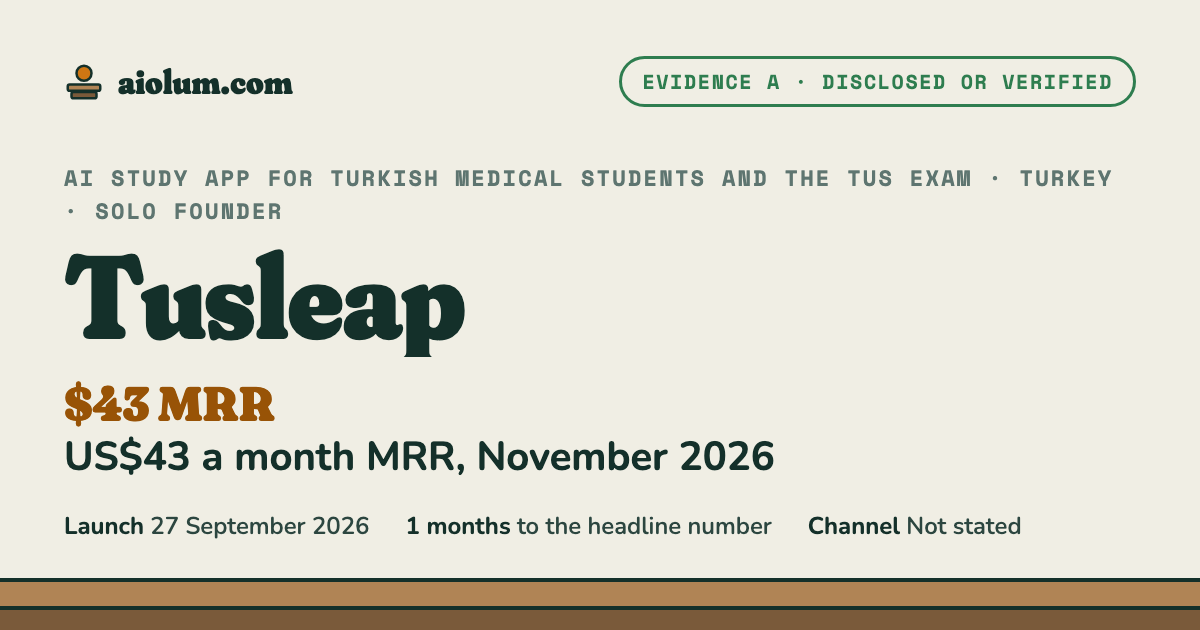
Tusleap (AI study app for Turkish medical students and the TUS exam, Turkey): US$43 a month MRR, November 2026. Evidence grade A: disclosed by a company or a filing, or verified by a payment processor. Team: 1 named owner, Ahmet Taha Tokmak, selling under the Opencie brand; headcount not published. Launched 27 September 2026; still running, revenue growing.Added 5 November 2026
- Outcome
- US$43 a month MRR, November 2026Revenue growing
- Evidence
- A disclosed by a company or a filing, or verified by a payment processor
- Launch
- 27 September 2026
- Status
- Still running
- Team
- 1 named owner, Ahmet Taha Tokmak, selling under the Opencie brand; headcount not published
- Outside funding
- None reported
- Group
- Learning and study
- Main channel
- Not stated
Tusleap is a study app for medical students in Turkey. Its main promise, on the home page, is "Hocanın slaytını yükle, sınav sorusuna çevir" ("Upload the lecturer's slide, turn it into an exam question", translation). The app also sells a ready question bank, a large set of practice questions with explained answers, which the App Store page gives as more than 170,000 questions, plus 218 or more mock exams for the TUS (Tıpta Uzmanlık Sınavı), the national exam that decides entry to medical specialty training in Turkey.
The App Store and Google Play list Ahmet Taha Tokmak as the developer, and the terms of use name him as the service provider "Opencie markasıyla" ("under the Opencie brand", translation). Version 1.0 appeared on the App Store on 27 September 2026. TrustMRR, a site that reads revenue from the payment provider through an API key, connects to the app's RevenueCat account (a service that records in-app subscription purchases from Apple and Google) and showed on 5 November 2026 a monthly recurring revenue (MRR, the subscription income expected each month) of US$42.57 from 7 active subscriptions, and US$80.01 in revenue since the start.
The figure is very small and very new, but it is verified from the payment records, grade A. This page shows what a one-person app for one national exam sells, how its prices are built, and what happened to earlier test-preparation companies that raised large amounts of money for the same kind of product.
How much revenue does Tusleap make?
Each row shows the evidence grade and the source numbers from the list at the end of this page. The grades are explained in How Aiolum verifies.
| Fact | Value | Grade | How we know | Sources |
|---|---|---|---|---|
| Monthly recurring revenue, 5 November 2026 | US$42.57 | A | TrustMRR metric snapshot, read from RevenueCat through an API key. Revenue last synced 5 November 2026. | [1] |
| Active subscriptions, 5 November 2026 | 7 | A | TrustMRR metric snapshot. | [1] |
| MRR per active subscription | about US$6.08 | calc | Calculated: 42.57 divided by 7 equals 6.08. | [1] |
| Revenue, last 30 days to 5 November 2026 | US$59.66 | A | TrustMRR gives last-30-day growth of +193.2%. | [1] |
| Revenue since the start | US$80.01 | A | October 2026: US$58.44. 1 to 5 November 2026: US$21.57. No revenue before October 2026. | [1] |
| First day with verified revenue | 17 October 2026, US$4.73 | A | From the daily table of the last 30 days. | [1] |
| MRR as a yearly figure | about US$511 | calc | Calculated: 42.57 times 12 equals 510.84. | [1] |
| First App Store version | 27 September 2026 | C | Version history on the App Store page. Version 1.0.6 followed on 26 October 2026. | [2] |
| Time from version 1.0 to the headline figure | 39 days | calc | Calculated: 27 September to 5 November 2026. | [1, 2] |
| Developer and seller | Ahmet Taha Tokmak, Opencie brand | C | App Store seller line; Google Play lists the developer as Opencie with his name; the terms say "Hizmet sağlayıcı / veri sorumlusu: Ahmet Taha Tokmak (Opencie markasıyla)" ("Service provider / data controller: Ahmet Taha Tokmak (under the Opencie brand)", translation). | [2, 3, 6] |
| Team size | not published | C | The home page has an unfilled template line for the size of the content team (see watch). | [4] |
| Outside funding | none reported | C | No source mentions investors. | [1, 6] |
| Content | 170,000+ questions, 3,000+ lessons, 218+ TUS mock exams | C | App Store text. The TUS page gives 219 mock exams, 70,000 TUS study questions, 30,000+ flashcards and 1,700+ lesson notes. | [2, 5] |
| Platforms | iPhone, iPad, Android | C | Google Play showed 100+ downloads, last updated 2 November 2026. The App Store showed too few ratings for an overview. | [2, 3] |
| Age limits | App Store 16+, Google Play Everyone, terms 18+ | C | The terms say the service is for users who are 18 or older, with no separate age check. | [2, 3, 6] |
| Law and market | Turkish law, Turkish-language app | C | Terms: "Türkiye Cumhuriyeti hukuku uygulanır" ("The law of the Republic of Türkiye applies", translation). The privacy policy follows KVKK, the Turkish personal data law. | [6, 7] |
How to read this table: a grade A value was read by TrustMRR from the app's RevenueCat account. A grade C value comes from the developer's own pages or store listings. A "calc" value (grade X) was computed on this page from the rows above it.
| Plan | Per month, billed yearly (US$) | Per month, billed monthly (US$) | Limit |
|---|---|---|---|
| Fakülte Plus Paketi | - | 14.99 | Faculty content, period not stated |
| 3 Aylık Fakülte Paketi | - | 5.00 | 14.99 for 3 months, faculty content |
| Yıllık Fakülte Paketi | 5.83 | - | 69.99 a year, faculty content |
| TUS Aylık Premium | - | 12.99 | TUS content, monthly |
| TUS 6 Aylık Premium | - | 11.67 | 69.99 for 6 months, TUS content |
| TUS Yıllık Premium | 10.00 | - | 119.99 a year, TUS content |
| 100 Yem | 1.99 one-time | 1.99 one-time | 100 AI credits |
| 500 Yem | 9.99 one-time | 9.99 one-time | 500 AI credits |
| 5000 Yem | 89.99 one-time | 89.99 one-time | 5,000 AI credits |
Faculty plans (Fakülte) cover the medical school curriculum; TUS plans cover the specialty exam. The terms say a faculty plan does not open the TUS mock exams and a TUS plan does not open all faculty content. Yem is the in-app credit used to make questions, notes and flashcards from the user's own files and to use Pigi; ready questions and lesson notes do not use credits. The App Store does not state the period of the Fakülte Plus Paketi. New users get a free trial period. Monthly prices of multi-month plans are calculated.
When did Tusleap launch, and how did it grow?
From the first App Store version to seven paying subscriptions in about six weeks. Each entry carries its grade.
- 21 September 2026CVersion 1.1 of the terms of use is published and comes into force. [6]
- 27 September 2026CVersion 1.0 of Tusleap appears on the App Store. [2]
- 10 October 2026CVersion 1.0.1 adds the 3D human atlas. [2]
- 17 October 2026AThe first verified revenue: US$4.73. [1]
- 22 to 26 October 2026CVersions 1.0.4 to 1.0.6 add study rooms, shared class notes, a notebook, a stopwatch for TUS study and exam scenarios; the monthly plan gets more Yem credits. [2]
- October 2026AUS$58.44 in verified revenue in the first month with sales. [1]
- 2 November 2026CGoogle Play update; the listing shows 100+ downloads. [3]
- 5 November 2026ATrustMRR shows US$42.57 MRR from 7 active subscriptions and US$80.01 since the start. [1]
Why did Tusleap work?
Four causes, in the order they mattered. Each one is a reusable lesson.
One exam, one country
The app serves one group: Turkish medical students in years 1 to 6 and doctors preparing for the TUS. Content, questions and the user interface are in Turkish, and the example questions follow the clinical-case style of the exam. A narrow audience makes the content plan clear, though it also limits the market size.
The lecturer's own slides
Each faculty writes its own committee exams, so a national question bank does not match every class. The upload feature turns the slides of the student's own lecturer into questions, a summary and flashcards. The home page says the generated questions stay inside the scope of the uploaded slide.
Subscription plus credits
Ready questions and lesson notes open with a subscription. AI generation and the voice assistant use Yem credits, which are included with the plans and also sold in packs on the App Store. This ties the variable cost of model calls to what the user pays.
Fast releases
The App Store lists seven versions between 27 September and 26 October 2026, each adding a feature such as the 3D atlas, study rooms or the notebook. The first verified payment came on 17 October 2026, three weeks after version 1.0.
How it was built
The developer's pages name few tools. These details come from the store listings, the privacy policy and the TrustMRR profile. [1, 2, 6, 7]
- In-app subscriptions and credit packs through the App Store and Google Play; RevenueCat records the purchases, and TrustMRR reads the revenue from RevenueCat.
- Sign-in only with Google Sign-In or Sign in with Apple, so the app stores no passwords.
- AI generation of notes, questions, flashcards and solutions, and the Pigi voice assistant, run on outside AI service providers in the USA and other regions; the privacy policy does not name them. Uploaded PDFs and question photos are sent to these providers and not kept permanently by Tusleap.
- The promotional site uses the Meta Pixel to measure page views and the effect of advertising.
- A 3D anatomy atlas of the human body, the eye and the brain, and a Campus feature where students of the same faculty share notes and questions.
Tools named in the sources
Each one opens its page in the Tools tab, with every story that uses it.
Who tried this before Tusleap, and why did they fail?
Three companies in our database of failed startups sold exam preparation software before language models could write practice questions from a student's own material. The values below are from that database and are not independently verified.
Grockit
The promiseSocial, game-like preparation for standardized tests such as the SAT, ACT and GMAT, with students studying together.
Why it diedLive group study was costly per user and hard to scale, and free online learning platforms copied the social and game features. Kaplan bought it in 2013 and it closed later.
Fenbi
The promiseOnline preparation for China's civil service and professional certification exams.
Why it diedChina's 2021 Double Reduction policy began a regulatory turn against commercial education, and the company did not survive it.
Byju's
The promiseVideo lessons, games and adaptive learning paths for school subjects and test preparation in India.
Why it diedIt sold through very large sales teams, spent heavily on acquisitions and marketing, and never reached profit; the database also cites weak learning results.
The failed startups come from our database of 1,749 dead startups, retold here in our own words. Its entries are AI-assisted summaries of public sources, so these cards carry no evidence grade.
What changed
Grockit, Fenbi and Byju's needed large teams to write questions, record lessons and sell, and they raised from US$44.4 million to US$6 billion according to the database. Their content was the same for every student who took the same exam.
A language model changes one part of that cost: it can turn a lecturer's own slides into practice questions and flashcards in minutes, for one student. Tusleap still sells a large ready question bank, but the per-student material comes from the model, which is what lets one named owner run the app. The open question, shown in the watch list, is whether students pay for that when general AI tools do similar work.
Can one person copy Tusleap now?
Yes, for another national exam in another language.
The parts are standard: a store app with subscriptions, a model that writes questions from uploaded files, and a ready question bank. The hard part is the content: a large, correct question bank in the exam's style takes time or an expert team, and medical questions must be accurate. The revenue so far is too small to show that the model works financially.
Where it is still open: The same model fits other national exams with their own style and language: law, nursing, pharmacy or engineering licensing exams, and university entrance exams for adults.
- 1Pick one high-stakes exam in one country where students study from local material in their own language.
- 2Build the feature that general tools do not have: questions in the exact style of that exam, from the student's own course files.
- 3Sell through the app stores with a monthly plan, a longer plan and credits for the AI features, so model costs follow use.
- 4Connect the payment data to a public verifier such as TrustMRR from the first sale.
What could go wrong for Tusleap?
The risks are the mirror image of the causes above.
Very small and very new
The headline is US$42.57 a month from 7 subscriptions, 39 days after version 1.0, with US$80.01 earned in total by 5 November 2026. TrustMRR shows +193.2% growth over 30 days, but from a base of a few dollars a day; one month of data does not show retention.
Competition from general AI tools
General AI tools already turn uploaded documents into study material. Google's help page for Gemini Notebook (formerly NotebookLM) says it can generate flashcards and quizzes from the sources a user uploads. Tusleap's difference is Turkish exam-style questions and a ready TUS question bank; a student who only needs questions from slides can use a general tool.
Dependence on AI providers
The privacy policy says notes, questions, solutions of photographed questions and the Pigi voice sessions are processed by outside AI service providers in the USA and other regions, without naming them. A change in their prices, terms or model quality changes the cost and the quality of the app's main feature.
Photo solutions and medical accuracy
The App Store text offers "Takıldığın sorunun fotoğrafını çek, çözümünü gör" ("Take a photo of the question you are stuck on and see its solution", translation), a feature also used by homework-answer apps. Here it is sold for exam study to adult medical students, and the terms forbid uploading confidential exam materials or unauthorized exam papers. The app warns that AI content can be wrong about drugs and doses and says it is not a medical advice service.
Unfinished pages and differences between them
On 5 November 2026 the home page still showed template placeholders in place of the content team ("[sayı] kişilik bir ekip", "[Ad Soyad]") and in place of user testimonials ("[Yorum] [Ad S.]"); no testimonial is presented as real. The terms say no separate Yem packs are sold, while the App Store lists Yem packs from US$1.99 to US$89.99. Age limits differ: 16+ on the App Store, Everyone on Google Play, 18+ in the terms.
Sources
The grade next to each source is the best grade that the source can support. "Read in full" means that the text of the page was downloaded and the numbers were checked in it.
- A TrustMRR profile: Tusleap (revenue last synced 5 November 2026)Read the markdown profile. Verified metrics from the app's RevenueCat account; the description and pricing text are founder-written (grade C).
- C App Store: Tusleap: Fakülteden TUS'a, by Ahmet Taha TokmakRead in full on 5 November 2026: description, version history with dates, age rating, seller and in-app purchase prices.
- C Google Play: Tusleap: Fakülteden TUS'a, by OpencieRead the listing: download count, content rating, update date and developer contact.
- C Tusleap home page: Hocanın slaytını sınav sorusuna çevirRead in full, in Turkish. Source for the slide-to-question feature, the free trial, the Yem credit and the template placeholders.
- C Tusleap TUS page: 219 deneme, 70.000 soruRead in full, in Turkish. Source for the TUS content counts and the study plan.
- C Tusleap Kullanım Koşulları (terms of use), version 1.1, 21 September 2026Read in full, in Turkish. Source for the service provider, the 18+ rule, the plans, Yem and the applicable law.
- C Tusleap Gizlilik Politikası (privacy policy)Read the sections on data recipients and transfers abroad. Source for the AI providers, sign-in, subscriptions and Meta Pixel.
- C Gemini Notebook Help: Create a notebook in Gemini NotebookRead in full. Cited only for the competing general tool that generates flashcards and quizzes from uploaded sources.
- C Database of failed startups, local exportLocal export. AI-written summaries, not independently verified. Source for the failed predecessors.
Run this company? Send corrections or a verified figure to aiolum@livyden.com