OpenWhispr: Revenue, team and how it was built
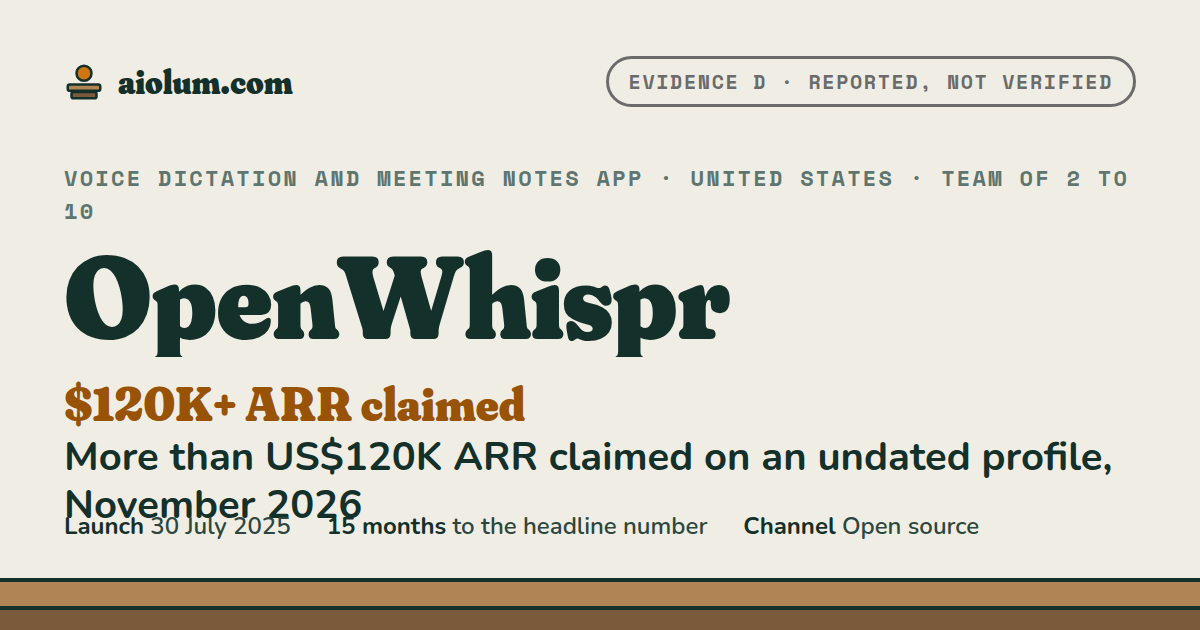
OpenWhispr (Voice dictation and meeting notes app, United States): More than US$120K ARR claimed on an undated profile, November 2026. Evidence grade D: reported, not verified. Team: 1 founder who built the first version alone; 3 people on the a16z speedrun profile read on 11 November 2026. Launched 30 July 2025; still running, revenue growing.Added
- Outcome
- More than US$120K ARR claimed on an undated profile, November 2026Revenue growing
- Evidence
- D reported, not verified
- Launch
- 30 July 2025
- Status
- Still running
- Team
- 1 founder who built the first version alone; 3 people on the a16z speedrun profile read on 11 November 2026
- Outside funding
- Shown as backed by a16z speedrun, cohort 007; the amount is not published
- Group
- Voice and audio
- Main channel
- Open source
What is not verified
The figure of US$120K+ in ARR rests on one source. It is the company profile on speedrun.a16z.com, read on 11 November 2026, with no date and no named author. A reader could look for a Stripe-verified profile or a founder interview with a date. The statement that paying users include employees at five named companies is on the same page and is also unconfirmed. The headline number is grade D: one claim or one estimate, with no second source. Aiolum shows it because the story is useful, and marks it so that it is not mistaken for a verified figure.
OpenWhispr is a voice-to-text app. It uses speech-to-text models, which are neural networks that turn recorded speech into written words. Open models such as OpenAI Whisper and NVIDIA Parakeet can run on a laptop, so the audio does not have to leave the machine. The app types the words at the cursor in any program and also records meetings. The code is published under the MIT open-source license, which lets anyone read, copy and reuse it.
The founder, Gabe Stein, launched the app on Product Hunt on 30 July 2025 under the spelling OpenWispr. In the launch thread he wrote that he built it himself because he could not justify paying for another AI tool subscription. The earliest copy of the website in the Internet Archive, from 17 August 2025, already offered a paid Mac edition for US$8 a month. By 11 November 2026 the GitHub repository showed about 11,400 stars, and the paid plans were Pro and Business, with Enterprise on request.
The headline figure is a claim on the company's profile at speedrun.a16z.com, the site of the a16z speedrun accelerator program. The profile says US$120K+ in ARR, growing 25% a month. ARR means annual recurring revenue, the yearly value of subscriptions. The page shows no date and does not name its author. It was read on 11 November 2026. No payment processor, press article or second source confirms it, so the grade is D.
Why did OpenWhispr work?
Four causes, in the order they mattered. Each one is a reusable lesson.
Free open-source code is the entry point to the paid plans
The code is free to clone and run. Users who found it on GitHub or Product Hunt can try it at no cost. The paid plans add cloud transcription, longer meeting recording and team tools. The GitHub star count rose from 942 to about 11,400 between January and November 2026. No source says how many paying users came this way.
The paid layer sells convenience to people who skip the setup
The website of August 2025 offered the paid Mac edition "for people too lazy to set it up themselves", with ready-made apps and automatic updates. The current paid plans keep that idea and add cloud transcription, a phone app and team features. The free plan keeps unlimited local models.
On-device processing is the pitch to privacy-sensitive companies
The company's home page says local dictation sends nothing to it. It also says that cloud audio is deleted when transcription finishes. The speedrun profile says the product is built for privacy-sensitive enterprises. These are the company's statements about its own product.
How it was built
These details come from the company's own pages, its public code listing and its careers page. They are grade C. [6, 9, 10, 3]
- The founder wrote on the careers page that he built the first version on his own. The code is MIT-licensed on GitHub.
- The desktop app uses Electron, React 19, TypeScript, Tailwind CSS v4, whisper.cpp and sherpa-onnx. Local speech models include OpenAI Whisper and NVIDIA Parakeet.
- The cloud service uses providers named on the security page: OpenAI and Groq for transcription, Parasail for agent features, Exa for web search. The page says all of them are opted out of training on customer data.
- The security page lists Neon for the database, Vercel for website hosting and Stripe for payments.
- Users can also bring their own API keys for cloud transcription on the free plan.
Tools named in the sources
Each one opens its page in the Tools tab, with every story that uses it.
Who tried this before OpenWhispr, and why did they fail?
Four companies in our database of failed startups built voice or audio software, or a note-taking app. The values below are from that database and are not independently verified.
Petalite
The promiseA privacy-first voice assistant, Mica, that runs on the device instead of the cloud.
Why it diedIt needed to sell hardware against Amazon and Google, which sold devices at or below cost. It could not match their prices on US$12M.
Nototo
The promiseA note-taking app that arranges notes on an infinite canvas.
Why it diedA small audience admired it, but it did not reach mass adoption. Notion offered team collaboration and integrations that it could not match.
Audobox
The promiseAudio feedback sharing for engineering, product and design teams.
Why it diedThe product was too narrow. Slack and Dropbox added collaboration features, and video tools such as Zoom and Loom took attention from audio.
Talkito
The promiseReal-time voice chats with the user's social network over the internet.
Why it diedUsers were used to text, and broadband was still young. Skype dominated voice, and the company had no clear way to earn money.
The failed startups come from our database of 1,749 dead startups, retold here in our own words. Its entries are AI-assisted summaries of public sources, so these cards carry no evidence grade.
What changed
The four records share one pattern. Each built a narrow product that a larger platform later covered: assistants from Amazon and Google, Notion for notes, Slack and Zoom for audio. Two of them, Petalite and Talkito, also needed their own hardware or voice infrastructure, which cost money before any customer paid.
OpenWhispr differs in cost structure, by its own description. The code runs on the user's computer, and the speech models it uses are published by others. The company's cloud costs come only from users who choose it. The risk remains that larger dictation and note-taking products add the same features. The company's pages show no sign that it has escaped that risk.
Can one person copy OpenWhispr now?
Partly. The open-source start is copyable; the revenue figure is not shown.
The method that the pages support is a free, open-source app that launches on Product Hunt and GitHub, followed by a paid hosted layer. The pages do not show how many people pay, so the size of the result is not known.
Where it is still open: Other tasks where an open model runs on a laptop. The user must care where the data goes. Examples are translation, transcription of calls and local search in notes.
- 1Build a small tool around published open models, and publish the code under a permissive license.
- 2Launch it on a developer channel, and answer every user thread yourself.
- 3Offer a paid edition for people who do not want to set it up, with automatic updates.
- 4Add cloud processing and team features later, and price them per user.
How much revenue does OpenWhispr make?
Each row shows the evidence grade and the source numbers from the list at the end of this page. The grades are explained in How Aiolum verifies.
| Fact | Value | Grade | How we know | Sources |
|---|---|---|---|---|
| Annual recurring revenue, claim read 11 November 2026 | US$120K+ | D | The OpenWhispr company profile on speedrun.a16z.com says "$120K+ in ARR, growing 25% MoM". The page has no date and does not name who wrote it. | [1] |
| Monthly value of that claim | at least US$10,000 a month | calc | Calculated: US$120,000 divided by 12. It rests on the same single claim. | [1] |
| Daily users, claim read 11 November 2026 | 10,000+ people daily, growing 30% a month | D | The same speedrun profile. Its short text says 10,000+ and its long text says "10,00+". | [1] |
| Paying users named by the profile | employees at Geotab, Siemens, Vista Equity Partners, Monobank and Bolt | D | The speedrun profile says paying users include employees at these companies. No source from those companies confirms it. | [1] |
| Launch | 30 July 2025, Product Hunt, as OpenWispr | C | The Product Hunt page lists the launch date. The maker in the thread is Gabe Stein of OpenWhispr. | [5] |
| First paid edition | US$8 a month or US$80 a year, Mac only | C | The company's website in the Internet Archive copy of 17 August 2025, with a 7-day free trial. | [4] |
| Current paid plans | Pro and Business, US$6.67 and US$13.33 a user a month billed yearly | C | Company pricing page, 11 November 2026. Monthly billing is US$8 and US$16. | [3] |
| GitHub stars | about 11,400 (shown as 11.4k) on 11 November 2026; 942 on 31 January 2026 | C | The repository page and an Internet Archive copy of it. Forks rose from 128 to 1,500 in the same time. | [6, 7] |
| Downloads, as the company states them | 150,000+ | D | The company's home page says "Downloaded by 150k+ users" and its careers page says about 150,000 downloads. Neither says how it is counted. | [2, 10] |
| Team | 3 people, with 1 founder named | D | The speedrun profile gives 3 employees and a founding year of 2026. The careers page lists three open roles. | [1, 10] |
| Legal entity | Gizmo Labs Inc., a Delaware corporation doing business as OpenWhispr | C | The company's terms of service and privacy policy. No page read gives the date of incorporation. An archived page of a second product, Pager, shows "© 2025 HeroTools Inc." in its footer. | [8, 17] |
| Funding | shown as backed by a16z speedrun, cohort 007; amount not published | D | The home page shows an a16z Speedrun logo under "Backed by" and the speedrun profile gives cohort SR007. Neither gives an amount. | [1, 2] |
| Time from launch to the headline claim | 15 months | calc | Calculated: 30 July 2025 to 11 November 2026, 469 days. | [1, 5] |
How to read this table. Grade D is a statement by the company or the founder that no second source confirms. Grade C is a company statement that agrees with a dated page. A "calc" value was computed on this page from the rows above it.
| Plan | Per month, billed yearly (US$) | Per month, billed monthly (US$) | Limit |
|---|---|---|---|
| Free | 0 | 0 | Unlimited local models, 2,000 words a week of cloud transcription, 5 hours of meeting recordings a month |
| Pro, per user | 6.67 | 8 | Unlimited cloud transcription, 20 hours of meeting recordings a month, agent mode, phone app |
| Business, per user | 13.33 | 16 | Unlimited meeting recordings, chat over your data, priority support |
| Enterprise | custom | Single sign-on, audit logs, retention controls, dedicated support |
The page shows the yearly price divided by twelve: Pro US$80 a year and Business US$160 a year per user. The monthly prices come from the pricing page's own question about paying yearly. A copy of the page from 30 June 2026 showed Business at US$200 a year per user.
When did OpenWhispr launch, and how did it grow?
From a Product Hunt launch of an open-source app in July 2025 to a paid product with a team plan, in 15 months. Each entry carries its grade.
- 30 July 2025CLaunch on Product Hunt as OpenWispr, an open-source speech-to-text app that runs locally. Gabe Stein writes that he built it because he could not justify paying for another AI tool subscription. [5]
- 17 August 2025CThe earliest Internet Archive copy of the website shows a free open-source edition and a paid Mac edition at US$8 a month. It also lists a custom Enterprise plan. [4]
- 31 January 2026CThe GitHub repository shows 942 stars, 128 forks and 420 commits. [7]
- 30 June 2026CThe pricing page shows Pro at US$6.67 and Business at US$16.67 a user a month billed yearly, with a free plan. [11]
- 13 October 2026CA second Product Hunt launch, OpenWhispr for iOS. [5]
- 29 October 2026CVersion 1.11.0 adds a shared team dictionary for Business and Enterprise members. [13]
- 11 November 2026DThe a16z speedrun profile claims US$120K+ in ARR and 3 employees. The pricing page shows Business at US$13.33 a user a month billed yearly. The GitHub repository shows about 11,400 stars. [1, 3, 6]
What could go wrong for OpenWhispr?
The risks are the mirror image of the causes above.
What is not verified
The figure of US$120K+ in ARR rests on one source. It is the company profile on speedrun.a16z.com, read on 11 November 2026, with no date and no named author. A reader could look for a Stripe-verified profile or a founder interview with a date. The statement that paying users include employees at five named companies is on the same page and is also unconfirmed.
Counters, badges and testimonials on the home page
These are the company's own display, and no independent source read here confirms them. The home page shows "Downloaded by 150k+ users" and an a16z Speedrun logo under "Backed by". The careers page says the app was downloaded about 150,000 times, and the speedrun profile says 10,000+ people use it daily. No page says how downloads are counted. The home page also shows the badges HIPAA, ISO 27001, SOC 2 Type II and GDPR. The company's trust center, which says it is powered by Comp AI, marks the four frameworks "Compliant". It names no auditor and lists 0 documents. Nine posts from X accounts are shown as testimonials, each linked to a post on X. The posts were not opened here, because X needs a login.
Start date and company name
The start used here is the product's launch on Product Hunt on 30 July 2025, under the spelling OpenWispr. The speedrun profile gives the founding year as 2026. The terms name Gizmo Labs Inc. as the company, and no page read gives its date of incorporation. The GitHub address HeroTools/open-wispr redirects to the current repository. The HeroTools page on GitHub links to openwhispr.com and to a second product, Pager, a team chat app. An archived copy of pager.team from 14 October 2025 shows "© 2025 HeroTools Inc." in its footer. No page read says how HeroTools Inc. and Gizmo Labs Inc. are related, or when Pager started.
Recording consent, teens and students
The product can record a meeting without the other people knowing, and the terms leave consent to the user. The meeting notes page says that no bot joins the call and "Other participants never know you're recording". The terms forbid recording a person "without their knowledge and consent where required by law". The terms also ban deepfakes and voice clones, and set the minimum age at 13. A use-case page headed "Speech-to-text software for kids" addresses parents and educators and names teens aged 13 and over. The student page offers lecture recording and says permission to record is the university's decision. It says an AI write-up needs a check of the university's rules before it goes into work handed in.
Outbound sales email and ad tracking
The trust center lists Lemlist among the company's subprocessors, "Used for outbound sales email sequences". It also lists AppsFlyer, which measures which ads lead to installs and subscriptions in the phone app. These are the company's own sales and advertising tools, not features that it sells.
Hiring while the profile lists 3 people
The careers page lists three open roles in San Francisco or Chicago. The team may be larger than the 3 people on the speedrun profile by the time a reader looks.
Sources
The grade next to each source is the best grade that the source can support. "Read in full" means that the text of the page was downloaded and the numbers were checked in it.
- D OpenWhispr - speedrun (a16z speedrun company profile)Read in full on 11 November 2026. The site has no robots file (404). Source for the ARR claim, users, team size, cohort and the founder's name. The page is undated.
- C OpenWhispr home pageRead in full on 11 November 2026. The robots file allows the page. Source for the counters, badges, testimonials, legal footer and the Backed by logo.
- C OpenWhispr pricing pageRead in full on 11 November 2026. The plans and limits are on the page. The monthly prices come from its question about paying yearly.
- C Internet Archive copy of openwhispr.com, 17 August 2025Read in full. The earliest copy found. Source for the first paid edition, the free tier and the footer of 2025.
- C Product Hunt: OpenWispr, launch of 30 July 2025, and its forum threadRead in full on 11 November 2026, with the product page. Source for the launch date, the maker's comment and the iOS launch of 13 October 2026.
- C GitHub: OpenWhispr/openwhisprRead the repository page on 11 November 2026. Source for stars, forks, the license, the tech stack and the redirect from the earlier repository address.
- C Internet Archive copy of the GitHub repository, 31 January 2026Read the header of the page. Source for 942 stars, 128 forks and 420 commits.
- C OpenWhispr terms of service and privacy policyRead the terms in full and the opening of the privacy policy on 11 November 2026. Source for the legal entity, minimum age and use rules.
- C OpenWhispr security pageRead in full on 11 November 2026. Source for the cloud providers, the database, hosting and payment services.
- C OpenWhispr careers pages: Founding Engineer and the role listRead in full on 11 November 2026. Written in the founder's voice (Hi, I'm Gabe, the founder). Source for the download count and the statement that he built the first version alone.
- C Internet Archive copy of openwhispr.com/pricing, 30 June 2026Read the plan section. Source for the earlier Business price.
- C OpenWhispr use-case pages: students and kidsRead both pages on 11 November 2026. Source for the notes on teens and on AI write-ups for students.
- C OpenWhispr changelogRead the top release on 11 November 2026. Source for version 1.11.0 of 29 October 2026.
- C database of failed startups, record pages of Petalite, Nototo, Audobox and TalkitoRecord pages read on the website on 11 November 2026. AI-written summaries, not independently verified. Source for the failed predecessors.
- C OpenWhispr AI meeting note taker pageRead in full on 11 November 2026. Source for the statement that no bot joins the call and that other participants do not know of the recording.
- C Gizmo Labs Inc. Trust CenterRead the overview on 11 November 2026. The host has no robots file (404). Source for the four frameworks marked Compliant and for the list of subprocessors.
- C Internet Archive copy of pager.team, 14 October 2025, and the HeroTools page on GitHubRead the archived home page in full and the GitHub page of HeroTools on 11 November 2026. Source for the second product, Pager, and the name HeroTools Inc.
Run this company? Send corrections or a verified figure to aiolum@livyden.com